
The bill key
Tap a shape
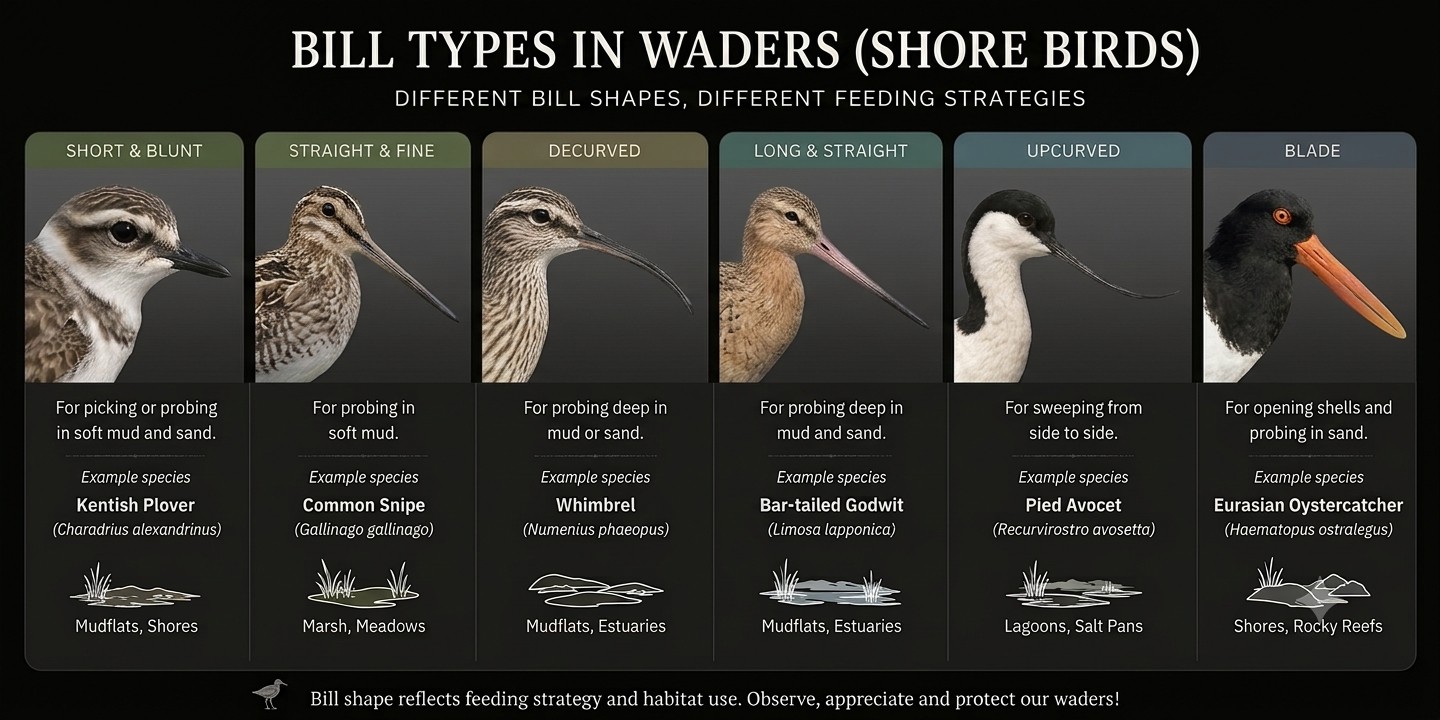
Bill shape is the first cut, and it is the one you can make from a bad photograph. It is also not arbitrary — the bill is a tool, and its shape tells you what the bird eats and therefore where on the flat you will find it. Short blunt bills belong to visual hunters that run, stop and peck at the surface. Long bills belong to birds that probe deep and feed by touch, often in water. Learn the six shapes and most sightings resolve to three or four candidates before you have looked at a single feather.
The size ladder
Body length · bill tip to tail
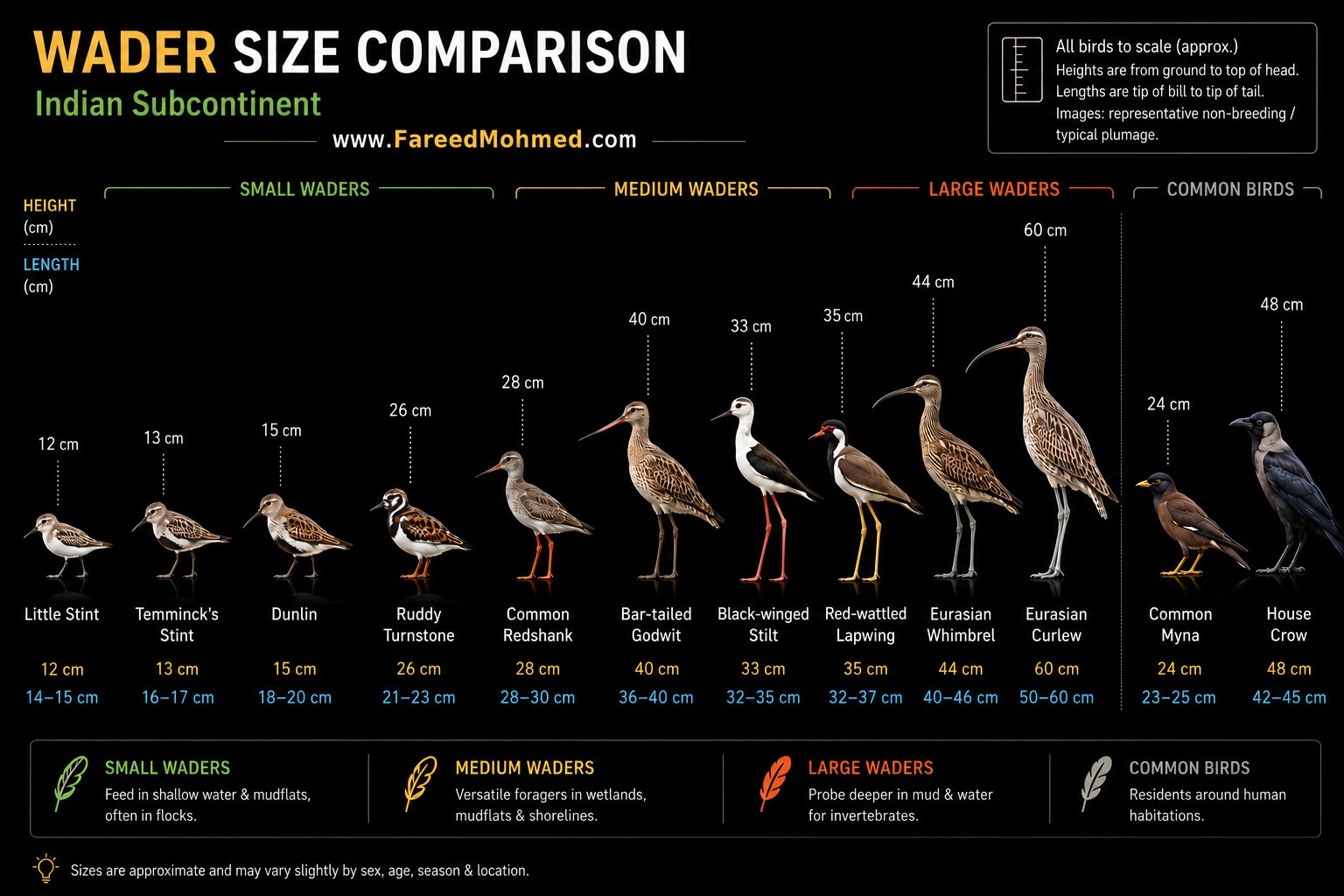
Size is nearly useless in isolation and decisive in comparison. On an open flat with nothing for scale, a Little Stint and a Dunlin look identical; put them in one frame and the question is over. This is the strongest argument for photographing mixed flocks rather than picking out the one bird you like — a frame with three species in it identifies all three. The two gold bars are the birds you already have a mental image of.
Typical published body lengths, bill tip to tail tip — not standing height, which is a smaller number. Ruff varies enormously: males are far larger than females, which is why a lone Ruff so often looks like the wrong bird.
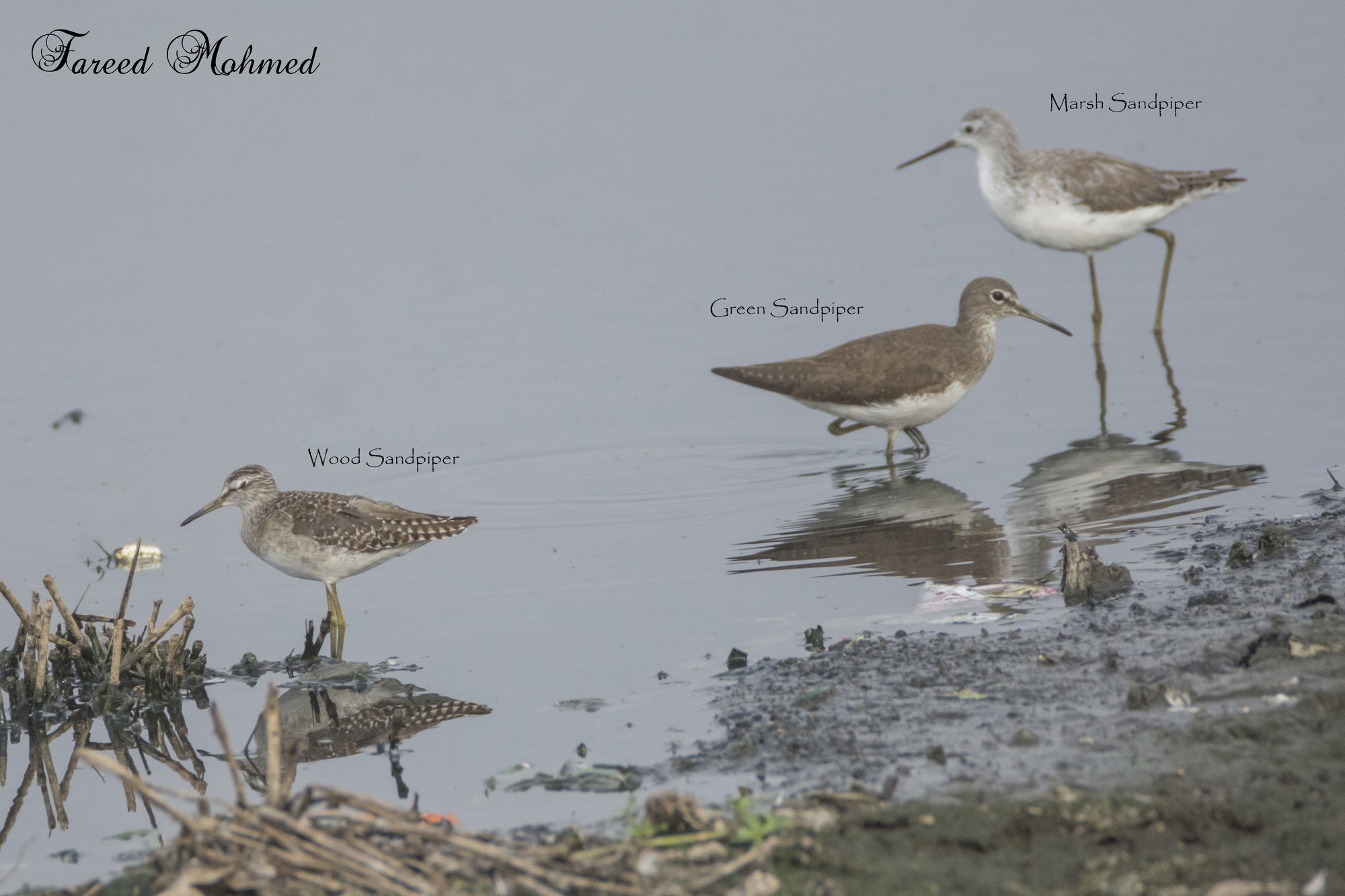
That frame does in one exposure what a page of measurements cannot. The Wood Sandpiper is the smallest and most heavily marked, the Green Sandpiper darker and more solid, and the Marsh Sandpiper stands above both on visibly longer legs with a needle bill. Photograph them on three separate mornings and you would still be guessing.
Six confusion pairs
One decisive tell each
These six account for most of the arguments. In each case there is one feature that settles it and several that do not — and knowing which is which is the difference between checking one thing in the field and photographing the bird from six angles hoping something helps. Where the tell is a flight feature, that is worth knowing before you press the shutter: you will need the bird in the air.
PAIR 01
Whimbrel vs Eurasian Curlew
Look at the head, not the bill
Both are big brown birds with long decurved bills, and bill length is a trap — a young Curlew has a shortish bill and a long-billed Whimbrel exists. The Whimbrel has a strongly striped head: dark lateral crown stripes with a pale stripe down the centre, and a dark eye-stripe. The Curlew's head is plain and unmarked.
Supporting: the Whimbrel is noticeably smaller and its bill kinks downward in the outer half rather than curving evenly along its whole length. The Curlew is the largest wader you will see in India and often looks it.
PAIR 02
Little vs Temminck's Stint
Leg colour
Little Stint has black legs. Temminck's has pale legs — yellowish, greenish or straw. That is the whole thing, and it works on any bird standing on dry ground in decent light.
Supporting: Temminck's is plainer and greyer, with a smooth grey-brown wash across the breast, and looks more like a miniature Common Sandpiper than a stint. Little Stint is more contrasty above, often with pale braces down the back. Habitat helps too — Temminck's prefers sheltered freshwater edges and creeks, Little Stint the open flat.
PAIR 03
Lesser vs Greater Sand Plover
Bill length against the eye
On Lesser Sand Plover the bill is roughly as long as the distance from its base to the back of the eye. On Greater it is clearly longer than that, and heavier — a blunt, swollen-tipped bill on a bird that looks slightly too big for its head. The measurement travels with the bird, which is why it beats overall size.
Supporting: Greater has longer, paler, greyish-green legs and a more attenuated look; Lesser is more compact with darker legs. In breeding plumage Greater tends to show a narrower rufous breast band. Mixed flocks are common, so look for a size step within the group.
PAIR 04
Common vs Wood Sandpiper
The white shoulder wedge
Common Sandpiper shows a white wedge pushing up in front of the folded wing, between the brown breast-side patch and the bend of the wing. Wood Sandpiper has nothing of the kind. Combined with posture it is instant: Common sits low and horizontal and bobs its rear end constantly; Wood stands taller and more alert.
Supporting: Wood Sandpiper has bright yellowish legs, boldly spangled upperparts, and a long supercilium running well behind the eye. In flight, Common flies low with stiff flicking wingbeats — one of the most recognisable flight actions of any wader.
PAIR 05
Black-tailed vs Bar-tailed Godwit
Get it in the air
Black-tailed Godwit shows a bold white wingbar and a clean black tail band against a white rump. Bar-tailed shows no wingbar at all, a finely barred tail, and a white wedge running up the back. Standing birds are far harder, so if both might be present, wait for a flush or a repositioning flight and take it.
Supporting: perched, Black-tailed is longer-legged with a straighter bill and stands taller; Bar-tailed is shorter-legged and its bill has a slight upward curve. Bar-tailed is the more strictly coastal of the two.
PAIR 06
Marsh Sandpiper vs Common Greenshank
Bill thickness, not length
Marsh Sandpiper's bill is needle-fine, perfectly straight, and thin along its entire length. Greenshank's is stouter, thicker at the base, and slightly upcurved. Both are grey-and-white birds with green legs, and at distance the shared colour scheme fools people constantly.
Supporting: Marsh Sandpiper is markedly smaller and daintier with proportionally longer legs, giving a delicate, stilted look. Greenshank is bulky, greyer, and has a loud ringing three-note call it uses often — frequently the first thing that tells you which one you are looking at.
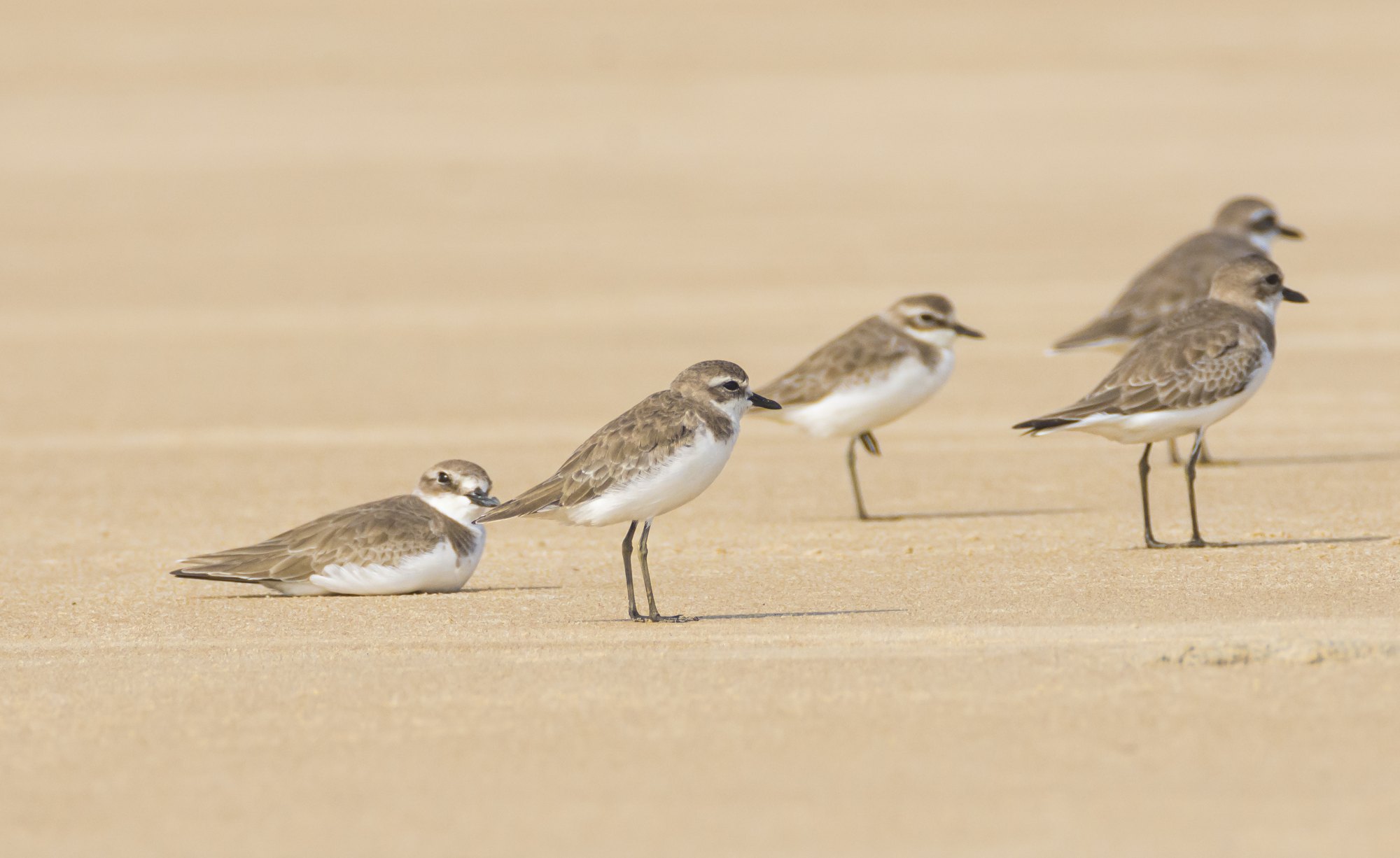
Groups like this are where sand plover identification is actually won. Alone, each of these birds is a pale brown plover on pale brown sand with nothing to measure it against; together, a step in size and bill weight within the group gives you somewhere to start. Take the group frame, then work on individuals in strict profile.
When they are here
The photographic year
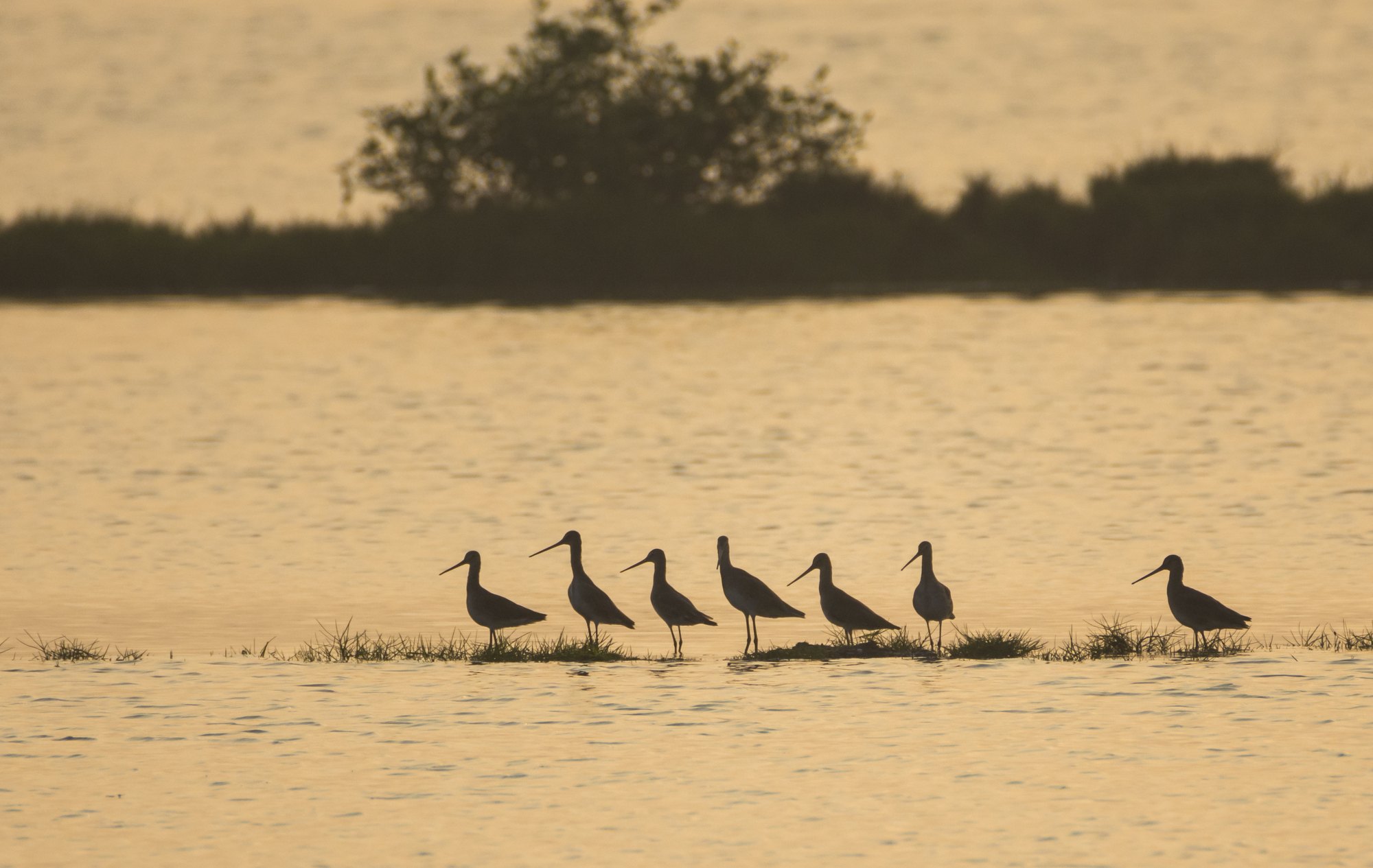
Almost every wader in this guide breeds somewhere north of India — the Arctic, Siberia, Central Asia — and is here only to spend the non-breeding season. That means the group has a hard season, and the difference between the right month and the wrong one is not a matter of a few more birds. In June there is nothing on the flat but residents.
Migrants presentArrival from about August, departure through April
Peak numbersHighest counts, dullest plumage, easiest finding
Breeding plumage windowThe short weeks the photographs are worth most
Aug – Oct · Arrival
Numbers building and the most varied months — passage birds pass through alongside those that will stay. Some adults arrive still carrying traces of breeding plumage, and juveniles are in crisp, neatly fringed first plumage that never looks this good again.
Nov – Feb · Peak
The most birds, the most species, the most reliable mornings. Everything is in grey-brown non-breeding plumage, so this is the season for behaviour, flocks and flight rather than for portraits of a spectacular individual.
Mar – Apr · Return
Numbers fall away, but the birds that remain start moulting into breeding plumage before they leave. A Curlew Sandpiper turns deep brick red, Grey Plover goes black-bellied and silver-backed, Black-tailed Godwit rusts over. Fewer birds, far better photographs — and a window of a few weeks.
Where to go
Eight sites · what each is actually for
Waders need shallow water over soft ground, so the map is a map of estuaries, lagoons, salt pans and seasonal wetlands. What separates a good wader site from a great one, photographically, is not species count — it is whether you can get to the birds' eye level without pushing them off the food. Salt pans and lagoon edges usually let you. Steep-banked reservoirs never do.
Pulicat Lake
Tamil Nadu / Andhra Pradesh
Nov – Feb
India's second-largest brackish lagoon, and a wader site on a scale that takes a few visits to read. Sanderling and stints on the sand, godwits and curlews on the flats, thick-knees on the dry margins, with terns and flamingos over the top of it all.
Vast, so pick one stretch and learn it rather than driving the shoreline. Most of my coastal collection is from here.
Point Calimere
Kodiakkarai, Tamil Nadu
Dec – Feb
Salt swamps and tidal mudflat at the point where the coast turns — one of the great wader congregations in southern India, with flocks large enough that scanning for a single odd bird is a genuine activity.
Flock and flight site more than a portrait site. Go for the mass, and for the chance of something scarce inside it.
Mangalajodi, Chilika
Odisha
Nov – Feb
A freshwater marsh on the northern edge of Chilika, worked from a flat-bottomed boat. Godwits, stints, Ruff, stilts and jacanas at absurdly close range, because the village turned from hunting to protection and the birds have not been pushed for years.
The best low-angle wader photography in the country — a boat puts your lens at water level automatically. Book a boatman who understands drifting rather than rowing at birds.
Sewri mudflats
Mumbai, Maharashtra
Dec – Mar
An urban intertidal flat that fills with flamingos and, less famously, a strong supporting cast of waders — godwits, redshanks, stints, sand plovers — pushed close by the rising tide.
Entirely tide-driven; check the table before anything else. The backdrop is a working port, so compose for it rather than against it.
Little Rann of Kutch
Gujarat
Nov – Feb
Seasonal saline flats with shallow standing water, and the best place in India for the long-legged specialists — avocets, stilts, sand plovers and big mixed flocks working the shallows in open light.
Flat, treeless and low, so vehicles can approach along the ground plane. The light is hard and clean; be finished by nine.
Nalsarovar & Thol
Gujarat
Nov – Feb
Freshwater wetlands rather than coast, which shifts the cast — Marsh Sandpiper, Wood Sandpiper, Ruff, stilts and Black-tailed Godwit in numbers, alongside cranes and ducks.
The freshwater complement to a coastal trip. Different species set, gentler light, more vegetation in the frame.
Kadalundi–Vallikkunnu
Kerala
Oct – Mar
An estuarine community reserve where the river meets the sea, with mudflats exposing on the falling tide. Sand plovers, stints, Terek Sandpiper, whimbrel and turnstones on a manageable scale.
Small enough to work properly in a morning, which makes it a good place to actually learn the birds rather than just list them.
Pallikaranai marsh
Chennai, Tamil Nadu
Nov – Feb
A freshwater marsh inside the city, and proof that you do not need a trip. Wood and Common Sandpiper, stints, Black-winged Stilt and Ruff, with a skyline of apartment blocks behind them.
Access is restricted in parts and the light is compromised by buildings early. Best treated as a practice ground — somewhere to fail cheaply before a real trip.
The craft
In the order it happens
Wader photography is unusual in that almost all the decisions are made before you see a bird. These are in sequence because they happen in sequence — get the first three wrong and nothing you do with the camera afterwards recovers the morning.
01
Read the tide before you read the map
On any tidal site the birds are where the water is not, and that moves. The window worth having is the two hours of a rising tide, when the flat is shrinking and the birds are being pushed steadily toward the shore — toward you. Feeding continues, distances close on their own, and you never have to take a step.
A falling tide does the opposite: the birds walk away from you all morning as new mud opens up. High tide itself concentrates everything into a roost, which is spectacular and almost useless for portraits — the birds are packed, asleep, and extremely easy to flush.
02
Pick the bank the sun will be behind
Waders live on open flats with no cover to hide the light. On an east-facing shore, first light comes across the water at you and every bird is a silhouette; on a west-facing bank at the same hour the same birds are lit and the water behind them goes dark. Decide which side of the water you need to be on the evening before, not at sunrise.
Wet mud is also a mirror. It will bounce light back up under a bird and open the shadows for free, and it will equally throw a hard specular sheet into the frame if the angle is wrong. Move a few metres and it changes completely.
03
Get down, then get down further
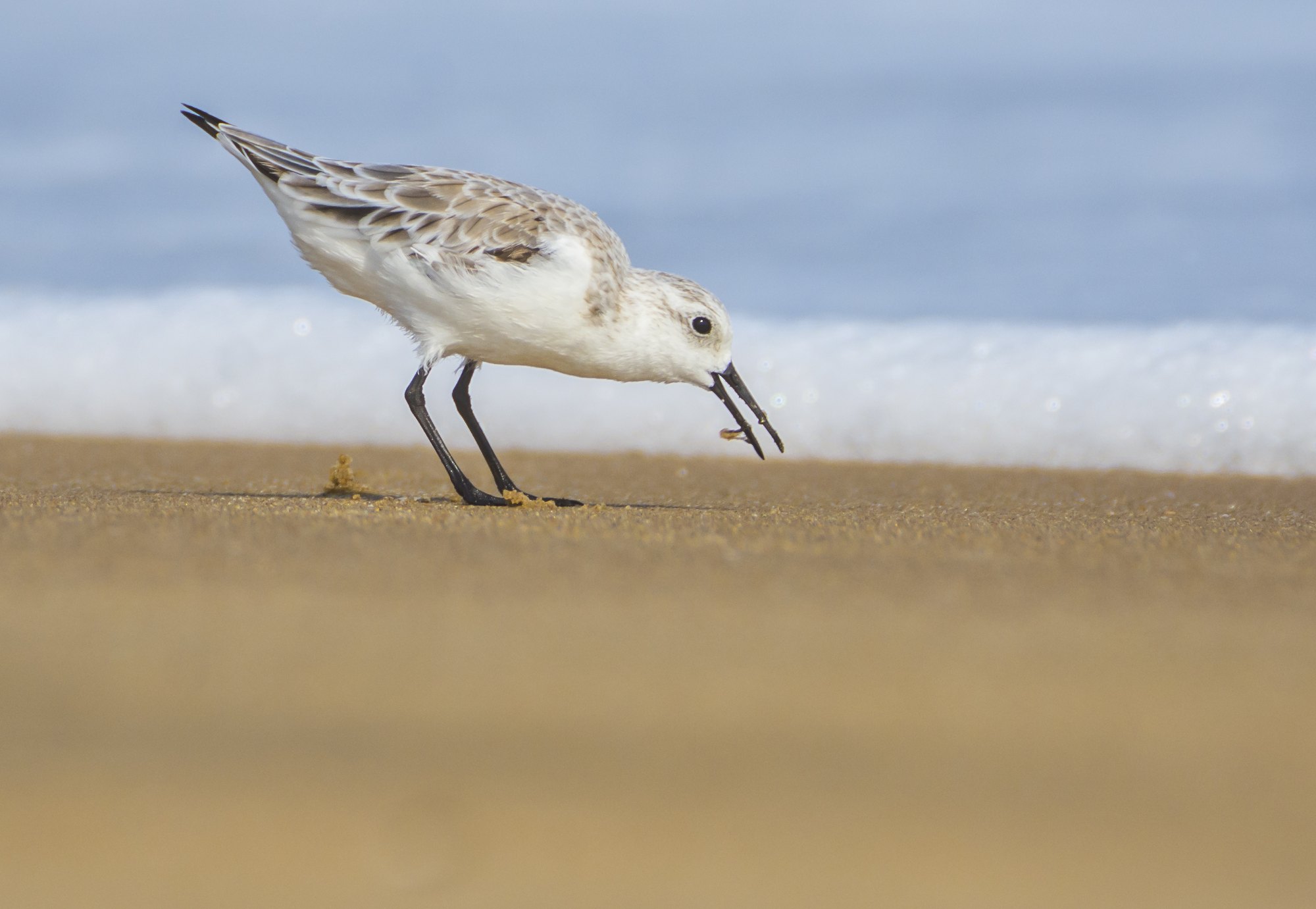
This is the whole game. A wader is fifteen to forty centimetres tall on flat ground — photograph it standing and you are looking down at a brown smudge on brown mud, with the ground rising behind it. Lie flat, put the lens on the ground, and the background collapses into a clean wash of blurred water and the bird separates completely.
Practically: a ground pod or a beanbag rather than a tripod, clothes you are willing to ruin, and a plastic sheet if the mud is soft. A tripod at its lowest setting is still usually too high.
04
Respect the break distance
Every species has a distance inside which it will not tolerate you, and crossing it costs you that bird plus everything else on the stretch — one flush can lift a whole flat. The reliable method is to get into position outside that distance, stop moving entirely, and let the birds walk to you, which they will do, because feeding waders travel steadily along the tide line.
If you must move, move low, slow and diagonally rather than straight in, and stop the moment a bird lifts its head and stands upright. That posture is the warning. Never walk into a high-tide roost — those birds are conserving energy for a migration measured in thousands of kilometres, and pushing them off is a real cost to them, not an inconvenience.
05
Expose for pale birds on wet ground
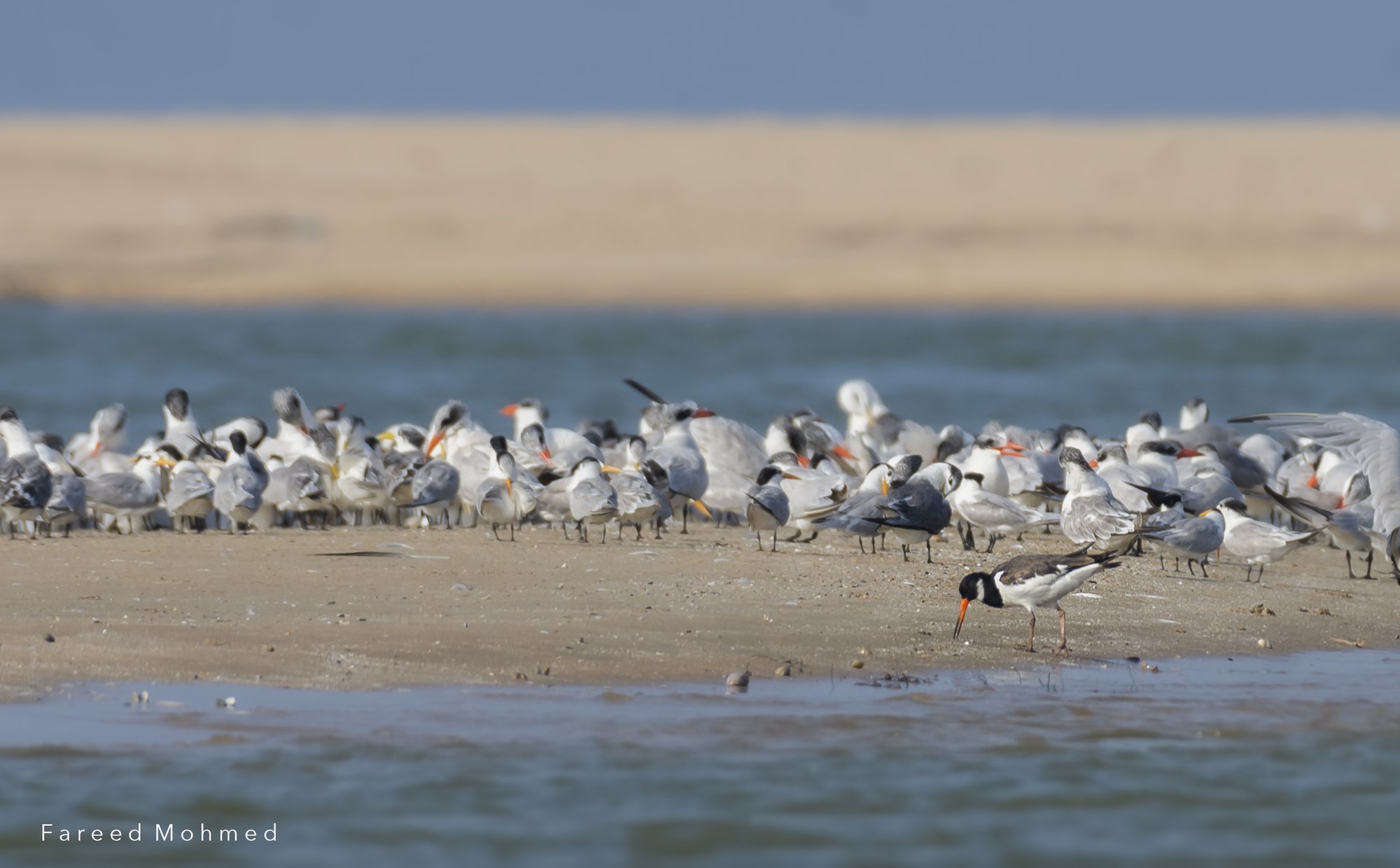
A Sanderling on wet sand is a small white bird on a mid-grey mirror, and most meters will underexpose it into grubbiness or blow the whites trying to lift the background. Work in manual or with deliberate positive compensation, and check the highlight warning on the bird rather than the frame.
For shutter speed: a walking wader is comfortable at 1/1000, a Sanderling sprinting the surf line needs 1/1600 or more, and take-offs and flock lifts want 1/2500. Waders are small subjects that fill little of the frame, so noise from a higher ISO is a cheaper problem than a soft wing.
06
Photograph the flock, not just the bird
Two habits that pay off later: shoot mixed groups deliberately, because a frame with three species in it settles all three sizes at once and becomes a reference you will come back to; and shoot the bird small in the landscape occasionally, because a wader at working distance on an open flat says something about the species that a frame-filling portrait cannot.
When you are working an identification problem, get the bird from the side with the bill fully in profile — a foreshortened bill has started more arguments than any other angle in this group.
07
Know when the morning is over
Heat shimmer over an open flat usually ends useful work by about nine, and no amount of stopping down or sharpening recovers a frame shot through moving air. Long lenses over hot ground are the worst case for it, and it arrives earlier than you expect on salt pans.
Which is the argument for having read the tide table: you have roughly three usable hours, and if the tide is falling through all of them you should have gone somewhere else.
What comes next
Waders 02 takes the small brown ones apart properly — thirteen species of stint and sandpiper, each with the one feature that settles it, and the two months in spring when they stop being brown. Waders 03 covers plovers and lapwings, the only wader group you can photograph without a tide. Waders 04 handles the long-billed and the specialists.
Meanwhile, the wader photographs on this site are mostly in the coastal collection, and the sites above appear on the map in bird photography with the checklists behind them.
The bill-types plate above is an illustration rather than a photograph; every other image on this page is my own from the sites listed.
Corrections are welcome. Identification writing goes stale and regional differences are real — if something here does not match what you see at your site, you are probably right about your site.