
Three questions
Ask them in this order
Before reaching for plumage detail, answer three things. In practice they resolve most small waders on their own, and they all survive the distances you actually work at.
01
What colour are the legs?
Black, yellow-green, orange-red, or bright orange. Leg colour carries more small-wader identifications than any other single feature, and unlike plumage it does not change with season or wear.
The catch is mud. A bird that has been probing has legs the colour of the flat, so wait for it to walk through water — they clean off in seconds.
02
How long is the bill, against the head?
Compare bill length to the length of the head, not to some remembered absolute. Shorter than the head, about equal, or clearly longer — three categories, and the ratio holds at any distance and any image size.
Then ask if it is straight, drooping at the tip, evenly decurved, or upturned. Only judge this in strict profile; a bird angled towards you has a shorter bill than it really has.
03
What is it doing?
Behaviour separates species that look nearly identical standing still. Constant tail-bobbing, creeping along a sheltered edge, sprinting the surf line, wading belly-deep, or walking steadily and probing — these are species-level habits.
Habitat is part of the same question. Open coastal flat, sheltered freshwater edge and flooded field hold overlapping but genuinely different casts.
The stints
Two species · 14 cm
The smallest waders you will see, and the ones people give up on. There are only two you are likely to meet in most of India, and they are separated by their legs — which sounds too easy until you are lying in mud watching a bird that will not step out of the water.
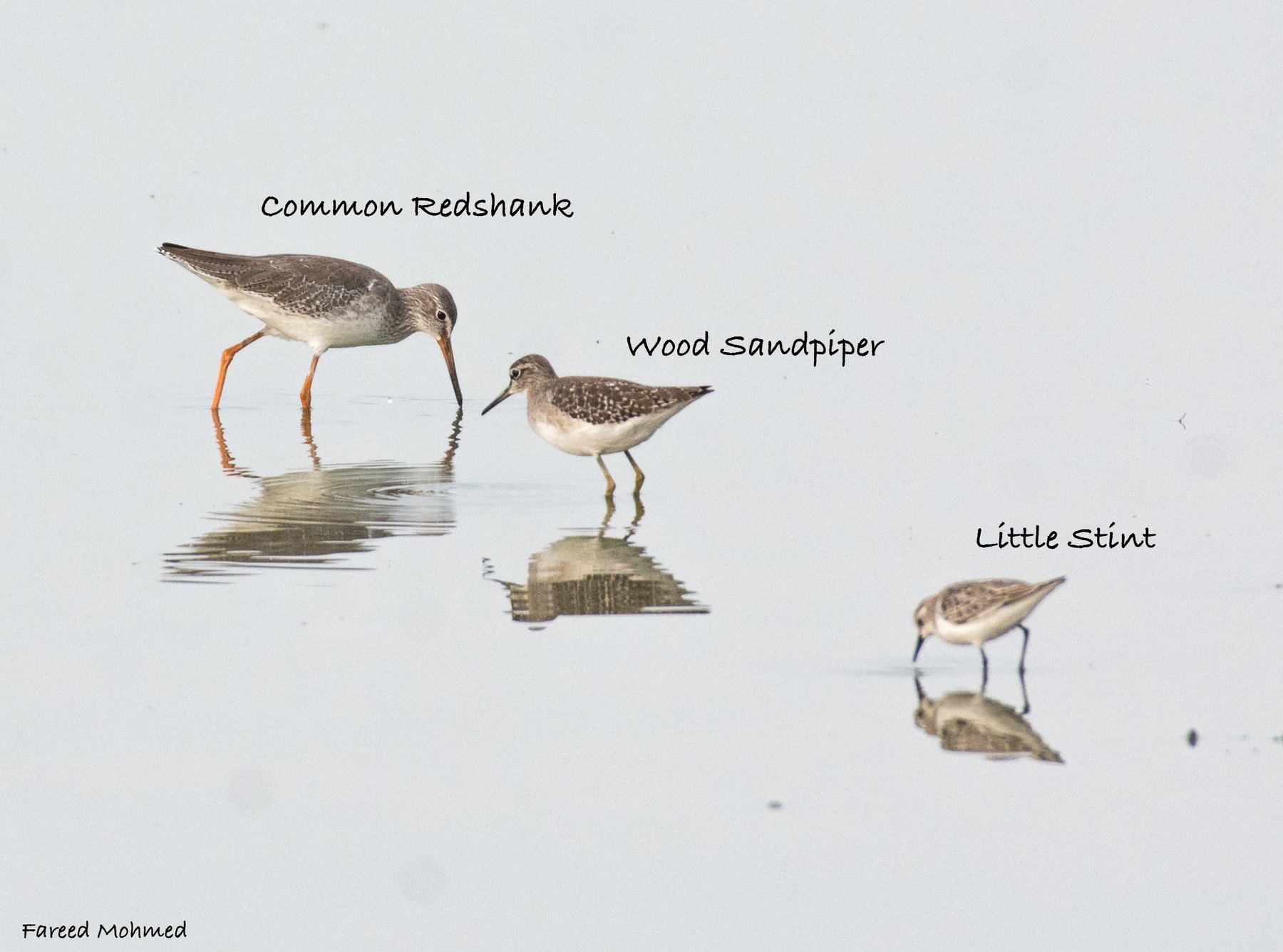
Tringa & kin
Six species · 20–33 cm
Longer-legged, more upright, more likely to wade than to run. Most are Tringa, the shanks and the freshwater sandpipers; Common and Terek Sandpiper sit in their own genera but behave like part of the same crowd. As a group these are the alarm birds of a wetland — noisy, watchful, and the first to go up.
The Calidris
Four species · 19–26 cm
Shorter-legged, stockier, and generally more social — these are the birds that form the packed feeding flocks on an open flat. They also change more dramatically between seasons than anything else in this guide, which is both the difficulty and the reason to be out in April.
Five confusion pairs
Where the arguments actually happen
Guide 01 covered the pairs that cross the whole group. These are the ones internal to the small brown waders, and they are the ones that will cost you time on any given morning.
PAIR 01
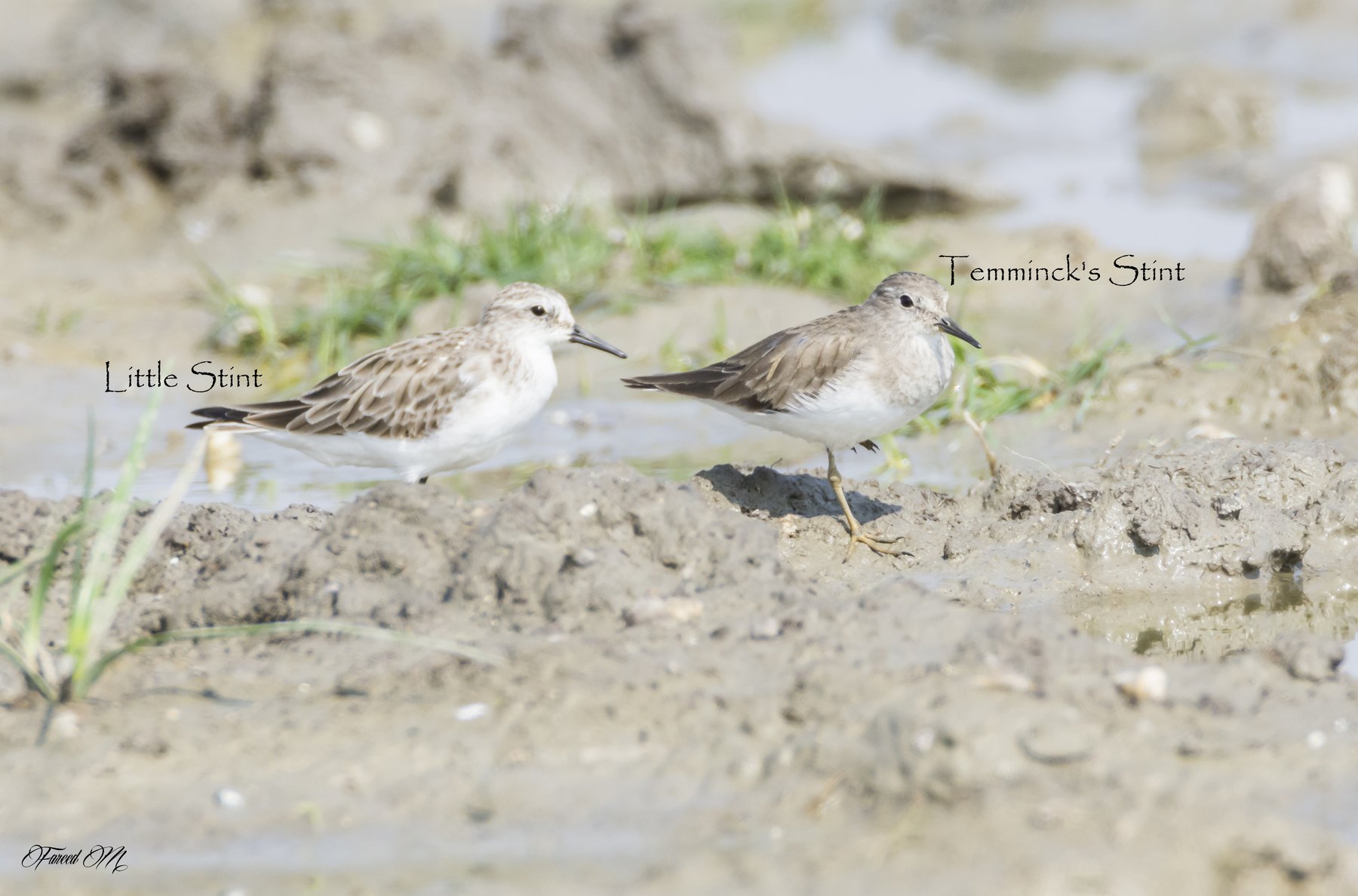
Little vs Temminck's Stint
Leg colour, then habitat
Black legs on Little Stint, pale yellowish or greenish on Temminck's. If the legs are hidden, use tone: Little Stint is contrasty, with pale edges to the upperpart feathers and often pale lines down the mantle; Temminck's is smooth, plain and greyer, with an unmarked breast wash that reaches right across.
Habitat helps before you have even raised the lens. Little Stint works open flats in loose flocks; Temminck's creeps along sheltered muddy edges, ditches and creek margins, usually alone or in twos, and looks more like a small Common Sandpiper than a stint.
PAIR 02
Wood vs Green Sandpiper
Supercilium, and how dark the back is
The Wood Sandpiper's white supercilium runs well behind the eye; the Green Sandpiper's barely reaches it. Wood is also paler and heavily spangled with buff above, where Green is dark olive-brown and finely speckled, with a sharp cut between dark breast and white belly.
In flight, the Green Sandpiper's blackish underwing against a white belly is unmistakable, and it usually flushes first with a ringing call. Wood is the more sociable, standing in the open on flooded fields; Green is the one that explodes out of a ditch you did not know it was in.
PAIR 03
Marsh Sandpiper vs Common Greenshank
Bill thickness
Needle-fine and dead straight on Marsh Sandpiper; stout, thick-based and slightly upcurved on Greenshank. Both are grey and white with green legs, and at distance they read as the same bird at different sizes — which is exactly the trap, because Marsh Sandpiper is smaller and more delicate but not by a decisive margin.
Structure is the fallback: Marsh Sandpiper has a small rounded head on a slim neck with proportionally very long legs, giving it a stilt-like look. Greenshank is bulkier and heavier-headed, and calls constantly.
PAIR 04
Curlew Sandpiper vs Dunlin
The rump, in flight
Curlew Sandpiper shows a clean white rump; Dunlin's rump has a dark centre. That is the settled answer, and it needs the bird off the ground — worth waiting for when a mixed flock is present.
Standing: Curlew Sandpiper is longer-legged and more elegant, with a longer, evenly decurved bill, and stands taller. Dunlin is dumpier and shorter-legged, with a bill that looks straight until the last third then droops. In spring the question disappears — Curlew Sandpiper goes deep brick red across the whole underside, Dunlin gets a black belly patch.
PAIR 05
Ruff vs everything else
No feature at all is the feature
Non-breeding Ruff is the bird that gets called something else more often than any other wader in India, because it has no strong marking anywhere and it varies enormously in size — a male can be half again as large as a female.
Look for a small head on a long neck, a slightly drooping short bill, a scaly-looking back where each feather has a pale fringe, and a pot-bellied, upright carriage. Leg colour is orange, yellowish or greenish and is not much help. The overall impression is of a wader assembled from spare parts, and once you have that impression it is quite reliable.
Craft
What this group demands
Guide 01 covered tide, light and getting low, and all of it applies here. These are the things specific to small waders — the birds that are too small to fill a frame and too similar to identify from a bad angle.
01
Photograph the legs, not just the bird
Half the identifications on this page turn on leg colour, and legs are the first thing lost — buried in mud, submerged in water, hidden behind a tussock, or in shadow under the body. If the bird is standing in water, wait for it to walk out. A frame with the whole bird sharp and the legs invisible has not answered the question.
The same applies to the bill in profile. A stint facing three-quarters towards you has a bill that looks shorter and blunter than it is, which is how Little Stints become Temminck's on a laptop screen at midnight.
02
Watch which bird is the sentinel
In a mixed group, Redshank and Greenshank go up first and take everything with them. Work out where those birds are before you move, and treat them as the ones setting your break distance, not the stints in front of you.
The corollary is useful: stints and Calidris are often remarkably tolerant of a motionless person lying flat, and will feed towards you until they are too close to focus on. The limit is almost never the small birds.
03
Faster than you think
A feeding stint never stops moving. The head is in constant motion even when the body is still, and at 1/500 the bill will be a smear in most frames. 1/1600 is a sensible floor for feeding birds and 1/2000 for anything running.
Small waders also fill very little of the frame, so you are cropping hard — which means noise from a higher ISO costs you far less than motion blur or a missed focus does. Push the ISO.
04
Take the flight shot
Several answers in this group only exist in the air: the rump pattern that separates Curlew Sandpiper from Dunlin, the broad white trailing edge on a Redshank's wing, the dark underwing of a Green Sandpiper, the white wedge running up a Greenshank's back.
When a flock lifts — for a harrier, a dog, a passing boat — shoot it rather than watching it. Those frames are frequently the ones that settle a bird you spent the previous hour arguing about.
05
Work the freshwater edge, not only the coast
Temminck's Stint, Wood Sandpiper, Green Sandpiper, Marsh Sandpiper and Ruff are far easier at a flooded field, tank margin or marsh edge than on an open coastal flat. A sewage-fed wetland on the edge of a town will out-produce a famous coastal site for this particular group, and it is usually twenty minutes away rather than four hours.
It also gives you backgrounds. Green water and reed reflections do more for a small brown bird than grey mud ever will.
06
Go back in late March
Everything in this guide is grey-brown from November to February. From about mid-March the birds that are still here begin moulting into breeding plumage before they leave, and a Curlew Sandpiper turning red is a completely different photograph from the same bird in December.
Numbers are falling in exactly the weeks the plumage is improving, so there are fewer birds and better frames. It is the trade most people never make because the season feels over.
Next
Waders 03 covers plovers and lapwings — the visual hunters, and the only wader group you can photograph without a tide. Waders 04 handles the long-billed and the specialists.
The framework behind all of this — the bill key, the size ladder, the season and the sites — is in Waders 01. More wader photographs are in the coastal collection.
Every photograph on this page is mine, and each is on the Macaulay Library with a checklist behind it. Corrections are welcome; regional variation is real, and if something here does not match what you see at your site, you are probably right about your site.