
Feeding deep
What a long bill is for
A plover finds food by looking at it. A godwit cannot see anything it eats. Everything about these birds follows from that difference — where they stand, how long they stay, how close they let you get, and what time of day they are worth photographing.
01
The bill is a sense organ
The tip of a godwit's or curlew's bill is packed with pressure receptors, so the bird detects buried prey by touch rather than sight — it can feel a worm several centimetres down without ever seeing it.
Which means darkness is no obstacle. These are the birds still feeding at dusk and through the night on a rising tide, long after the plovers have stopped.
02
Depth is the niche
Bill length and leg length together decide how deep a bird can work, and that is how half a dozen species share one flat without competing. Stints take the top centimetre; godwits take fifteen; a curlew reaches deeper still, into crab burrows nothing else can follow.
Practically, this tells you where to point the lens. On a falling tide the long-billed birds hold the deeper water while the small waders work the newly exposed edge.
03
Big birds are wary birds
Flush distances scale with size. A Little Stint may feed to within a few metres of a motionless person. A Eurasian Curlew will lift at eighty and take the entire flat with it.
So this group is worked at range, from cover, or from a vehicle — and much more often photographed in flight than the smaller waders, partly by necessity and partly because that is where the identifications live.
The godwits
Two species · settled in flight
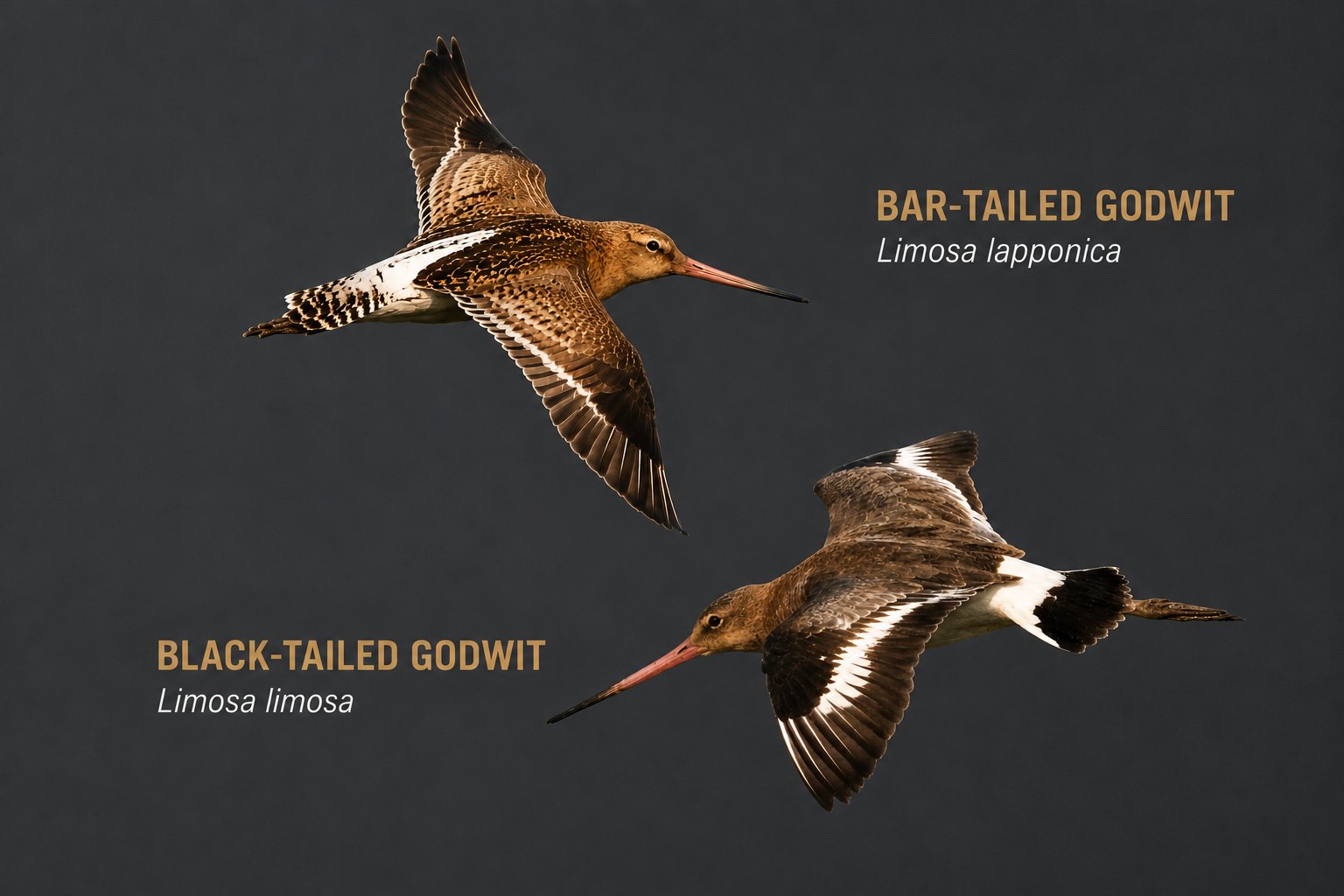
Two large, long-billed, long-legged waders that look extremely similar standing and completely different flying. If both might be present — and on the Indian coast they often are — the frame you actually need is the one where the bird has its wings out.
The curlews
Two species · read the head
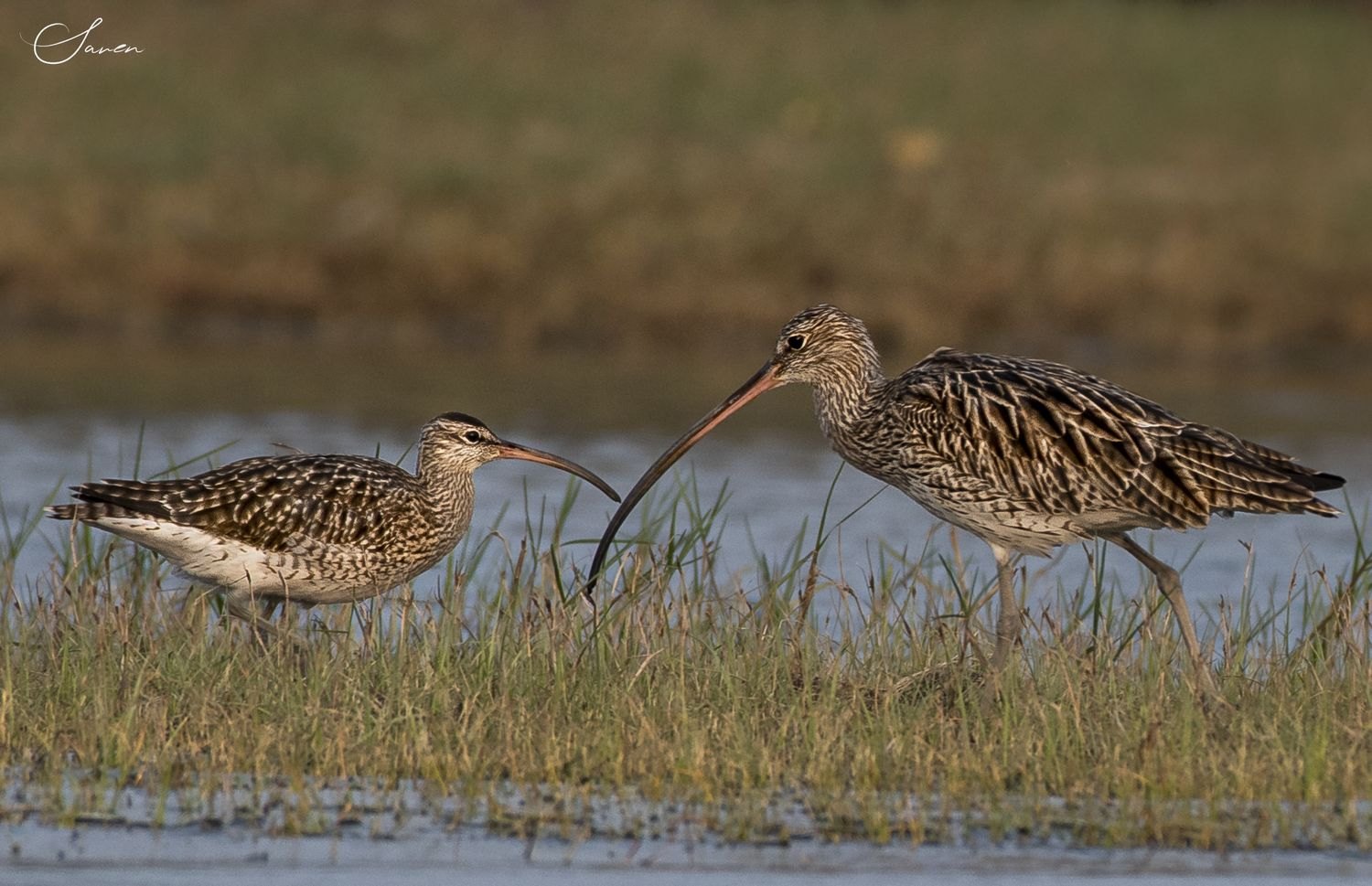
Both have long decurved bills, both are brown and streaked, and bill length is the trap — a young Curlew has a short bill and a long-billed Whimbrel exists. The head pattern does not vary in the same way, which is why it is the feature to use.
The specialists
Four species · four solutions
None of these needs separating from anything else — they are the most instantly recognisable waders in India. They are here because each one demonstrates a different answer to the same problem, and because the bill of each is a tool built for exactly one job.
Three confusion pairs
One decisive tell each
PAIR 01
Black-tailed vs Bar-tailed Godwit
Wingbar and tail — in flight
Black-tailed Godwit shows a bold white wingbar down the length of the upperwing and a clean black tail band against a white rump. Bar-tailed shows no wingbar at all, a finely barred tail, and a white wedge running up the back.
Standing birds are much harder. Black-tailed is longer-legged and stands taller, with a straighter bill and a plainer, greyer look; Bar-tailed is shorter-legged, more streaked and mottled above, with a bill that curves slightly upward. Habitat helps: Bar-tailed is strongly coastal, Black-tailed frequently inland on freshwater wetlands and flooded fields.
PAIR 02
Whimbrel vs Eurasian Curlew
Crown stripes, not bill length
Whimbrel has a boldly striped head — dark lateral crown stripes with a pale stripe between them, and a dark eye-stripe. The Curlew's head is plain and unmarked. This works on a standing bird, a flying bird, and a bird half-hidden in grass.
Supporting: the Curlew is considerably larger and its bill curves evenly along its whole length, where the Whimbrel's is shorter and kinks downward in the outer half. Both calls are distinctive — the Whimbrel's is a rapid even-pitched whistled trill, the Curlew's a rising, mournful two-note cry.
PAIR 03
Great vs Indian Thick-knee
Bill shape and where you are standing
Great Thick-knee has a massive, heavy, slightly upturned black-and-yellow bill and a bold black-and-white face pattern. Indian Thick-knee is smaller and plainer, with a short mostly dark bill and a subtler face.
Habitat separates them almost completely. Great Thick-knee wants open sand and shingle beside water — river islands, estuary bars, coastal flats. Indian Thick-knee is a dry-country bird of scrub, orchards, fallow land and open woodland edge, often nowhere near water at all.
Craft
What this group demands
Bigger birds, longer distances, and one group where the flight shot is not a bonus but the point. Everything in Waders 01 about tide and getting low still applies; these are the additions.
01
Set up for the flight shot before you need it
Godwit and curlew identifications live in the upperwing and tail, and those frames arrive without warning — a harrier goes through, a boat passes, the flock repositions. If you are waiting on a flock that might lift, pre-set an exposure for a bird against bright sky and keep it on a custom button, because you will not have time to think about it.
Practically: at least 1/2000, a stop or more of positive compensation against sky, and focus tracking already engaged. Shoot the lift, not the aftermath.
02
Accept the distance, then reduce it properly
You will not walk up to a curlew. The reliable approaches are a vehicle on a bund, a boat drifting rather than rowing, or lying in position before first light and letting the birds arrive around you. The last one is by far the most productive and the least comfortable.
Failing all that, use the distance. A curlew at eighty metres in dawn mist, small in the frame, is a better photograph than a frame-filling one taken from standing height at noon.
03
Compose for the bill
A long bill dictates the frame. Leave room in front of the bird — considerably more than feels natural — because a curlew cropped tight to its bill tip looks like a mistake rather than a decision. Horizontal frames suit this group almost always.
Head-down probing is the characteristic posture but a poor photograph, since the head disappears. Wait for the lift: the bird raises its head to swallow every few probes, and that half-second is the frame with the eye in it.
04
Shoot the action, not the portrait
Each of the specialists does something visually specific and repeatable. An avocet sweeps its bill side to side through the water in a scything arc; an oystercatcher hammers and prises at a shell; a stilt picks delicately from the surface on legs that look borrowed. Those behaviours are the photograph.
All of them are rhythmic, which means predictable. Watch one bird for a full cycle before shooting, work out where the peak of the action falls, then wait for it to come round again.
05
Thick-knees are the exception — go slow
Great Thick-knee relies on stillness rather than distance, and will often let you approach far closer than any other bird in this guide. It is also largely crepuscular, so first and last light are when it is active rather than crouched.
That enormous eye is the whole subject and it needs a catchlight. Work at eye level, wait for the bird to turn its head so the light reaches the eye, and accept that the rest of the plumage is deliberately dull.
06
These are the birds that read as shapes
Long legs, long bills and big bodies survive being reduced to silhouette in a way that a stint never does. A line of godwits against gold water at sunrise is a photograph; a line of stints in the same light is a smudge.
Which makes this group the one to work when the light is behind the birds rather than behind you — the situation that ruins most wader mornings and makes this one.
End of the series
That completes the waders: 01 the framework, 02 sandpipers and stints, 03 plovers and lapwings, and this one. Herons, egrets, storks and ibises wade but are not waders in the sense used here, and pose a completely different photographic problem — they will get their own guide.
More wader photographs are in the coastal collection, and the sites behind them are on the map in bird photography.
The godwit flight comparison is an illustration. The Whimbrel and Eurasian Curlew frame was photographed by Saranya Subramanian and appears here with her permission; every other photograph on this page is mine. Corrections are welcome.