
How plovers work
Why the group looks the way it does
Sandpipers feed by touch, walking steadily and probing soft mud with a long sensitive bill. Plovers feed by sight, and their whole structure is built around that one difference. Understanding it tells you where to find them, when they are active, and why they behave as they do in front of a lens.
01
The eye is the tool
Plovers have disproportionately large dark eyes because they are visual hunters, and large eyes gather light — which is why plovers keep feeding well into dusk and on moonlit nights, long after the probing waders have stopped.
In practice that extends your working day at both ends. A plover flat at last light is still productive when everything else has gone quiet.
02
Open ground, not soft mud
They want firm open surfaces where prey is visible: dry sand above the tide line, salt pan bunds, short grass, ploughed fields, airfields. Soft intertidal mud is for the probers.
This is why plovers do not need a tide. It also means the light is usually harder and the backgrounds emptier than on a mudflat, which changes how you compose.
03
Run, stop, tilt, take
The rhythm is fixed and worth learning, because the stop is your frame. The bird runs several paces at speed, freezes, tilts forward to look, takes the item and runs again.
You cannot follow it through the run and expect sharpness. Anticipate the stop, or pre-focus on ground the bird is working towards and wait for it to arrive.
The sand plovers
Two species · the hard pair
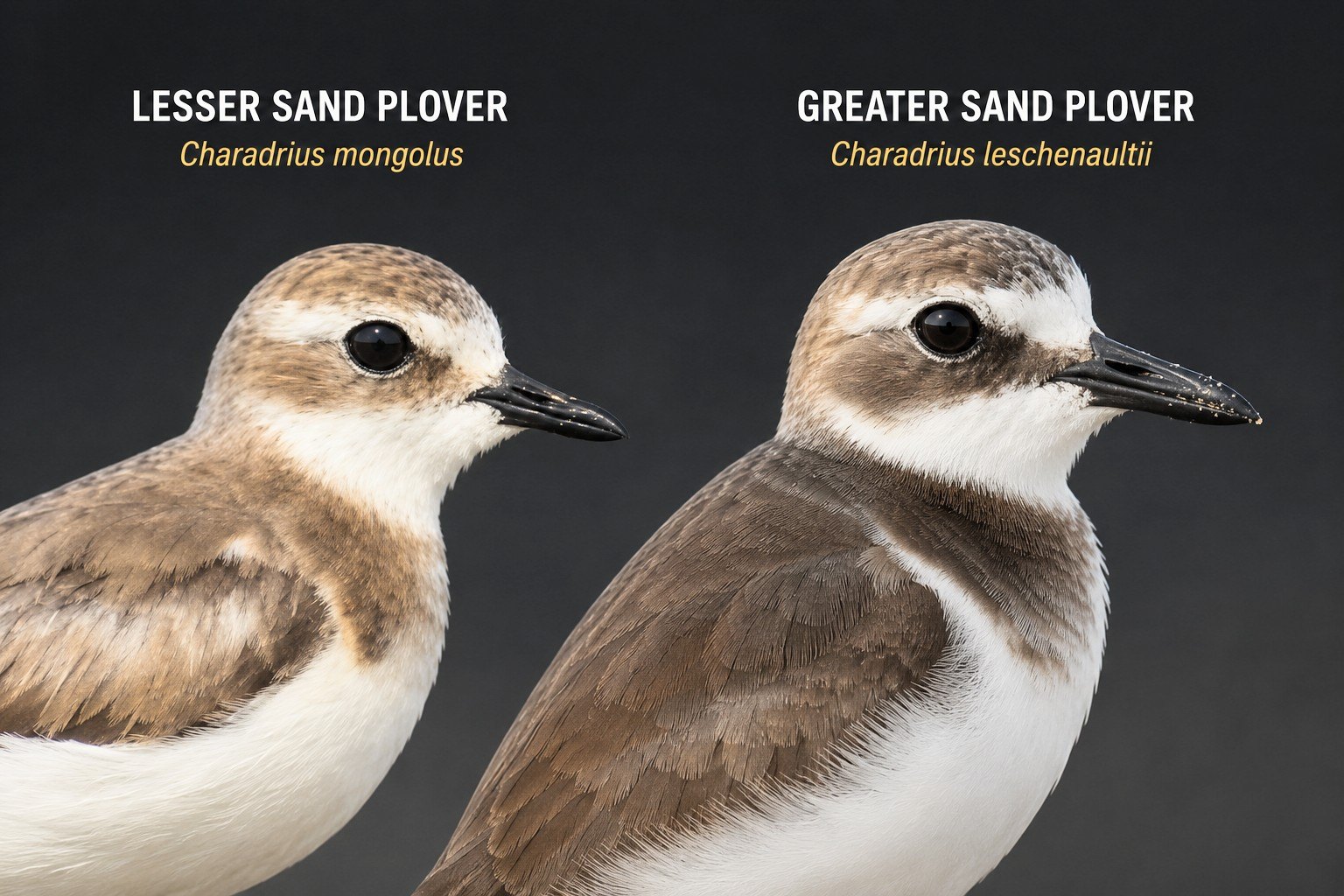
The genuinely difficult identification in this guide, and one that has become more interesting rather than less. Both are plain sandy-brown non-breeding waders of coastal flats, and both are common. The answer is in the bill — measured against the head rather than in absolute terms, because absolute size is exactly what you cannot judge on an empty flat.
A note on the split
What used to be a single Lesser Sand Plover has recently been divided by most authorities into two species — Siberian Sand Plover and Tibetan Sand Plover — which is why eBird may now offer you names you have not seen before, and why an older photograph can end up relabelled without you touching it.
For a photographer the practical consequence is small but worth knowing: the two are extremely difficult to separate in non-breeding plumage, which is when almost all of us see them in India. Unless you have a bird in full breeding plumage, or good views of head pattern and structure, leaving a record at the pre-split level is the honest answer rather than the lazy one. Older references — including the comparison plate above — use the genus Charadrius for these birds; current lists place them in Anarhynchus.
The small plovers
Two species · 15–17 cm
Both are small, both have a breast band, and both nest on open ground in India rather than merely wintering here. They separate instantly on face pattern once you know what to look at — and one of them has the most distinctive single feature of any plover on this page.
The big plovers
Two species · Pluvialis
Substantially larger, longer-winged, and the two most spectacular birds in this guide for about six weeks in spring. In winter they are grey or gold and easy to walk past; in April they turn black underneath and become something else entirely.
The lapwings
Two species · resident
Lapwings are plovers that stayed. Both of these are resident, breed here, and are on ground you drive past daily — which makes them the easiest subjects in the series and, for exactly that reason, the ones most people have no good photograph of.
Four confusion pairs
One decisive tell each
PAIR 01
Lesser vs Greater Sand Plover
Bill length against bill-base-to-eye
On Lesser the bill is roughly as long as the distance from its base to the back of the eye. On Greater it is clearly longer than that — and also deeper at the base and blunter at the tip, giving the bird a slightly front-heavy look.
Supporting: Greater is larger with longer, paler greyish-green legs and a more attenuated rear end; Lesser is compact and rounder with darker legs. In a mixed flock look for a size step. Judge the bill only in strict profile — a bird angled towards you loses length fast.
PAIR 02
Kentish vs Little Ringed Plover
The eye-ring, and whether the band is complete
Little Ringed Plover has a bright yellow eye-ring and a complete black breast band. Kentish Plover has no obvious eye-ring and a broken band — two dark patches at the sides of the breast that never meet.
Supporting: Kentish is paler and sandier overall, often with a rufous wash to the crown, and is a bird of coastal sand and salt pans. Little Ringed is darker, browner, and favours freshwater — river sandbars, tank margins, quarry pools. The eye-ring alone settles it whenever the head is visible at all.
PAIR 03
Grey vs Pacific Golden Plover
Tone, and the black armpit in flight
Grey Plover is cold grey and white; Pacific Golden Plover is warm gold and buff. Once you have seen them side by side the tone difference is obvious, but alone on grey mud in flat light it is less so.
The certain answer is in flight: Grey Plover has a black patch in the armpit — the axillaries — that flashes as it lifts. Pacific Golden has none. Structurally Grey is bulkier with a heavier bill; Pacific Golden is slimmer, longer-legged, and more often on short grass and field edges than on the open flat.
PAIR 04
Red-wattled vs Yellow-wattled Lapwing
The face, and the habitat
Red-wattled has a black head and breast, a bold white neck stripe, a red wattle before the eye and a red bill with a black tip. Yellow-wattled has a brown cap, a bright yellow wattle and yellow bill base, and no black on the breast at all.
Habitat separates them before you get close. Red-wattled wants water nearby — tank edges, wet fields, ditches, and it is the noisiest bird in any Indian landscape. Yellow-wattled prefers dry open country: stony scrub, fallow fields, grazing land, and it is far quieter and much less often photographed.
Craft
What this group demands
Plovers reward a different plan from the rest of the series. No tide table, no soft mud, no rush to be finished by nine — but a harder light problem and a subject that will not hold still for more than half a second at a time.
01
Shoot the stop, not the run
The run-stop-tilt-take cycle gives you a reliable half-second of stillness, and that is the frame. Track the bird through the run with the shutter closed, and fire on the freeze — trying to keep a sprinting plover sharp is a way of filling a card with nothing.
The alternative is to commit fully the other way: 1/2500 or faster on a running bird, low, with the legs mid-stride. That is a genuinely different photograph and worth having, but do not expect to get both in one pass.
02
Use the vehicle
On dry flats, salt pan bunds and grazing land, plovers that will not tolerate a person on foot at forty metres will feed calmly beside a stationary car. A vehicle is the most effective hide available in Indian wader photography, and on a plover site it usually beats crawling.
Switch the engine off, stay inside, use a beanbag on the window frame, and let the birds come back — they do, within a minute or two. Do not open a door.
03
The light lasts longer, the haze arrives sooner
The big eyes mean plovers keep feeding into dusk and start before proper sunrise, so you have more usable time than with any other wader group. Last light on a plover flat is often the best hour of the day.
Against that, dry sand and bare earth heat faster than wet mud, so shimmer through a long lens can ruin a mid-morning session earlier than it would on an estuary. Take the early and late ends and give up the middle.
04
Expose for pale sand, not for the bird
A sand plover on dry sand is a mid-brown bird on a bright background, and the meter will pull the whole frame down. Add exposure and watch the highlight warning on the sand rather than on the bird, or you will spend the evening lifting shadows out of a plover.
Overcast is genuinely better for this group than hard sun. Flat light on pale sand holds detail in both the bird and the ground, and the harsh shadow under a plover's breast disappears.
05
Know when you are near a nest
Kentish Plover, Little Ringed Plover and both lapwings nest on bare open ground in India, mostly between March and June. The nest is a scrape with no structure at all and eggs that are effectively invisible — you will not see it before you step on it.
The warning signs are behavioural: a bird calling insistently and circling, standing over one spot, or running away from you with a wing trailed as though broken. All of these mean leave, immediately and in the direction you came from. A distraction display is a bird telling you its eggs are within a few metres of your boots, and a lapwing kept off a scrape in the sun loses the clutch quickly.
06
Go back for the black bellies
Grey Plover and Pacific Golden Plover in breeding plumage — jet black from face to belly, silver-spangled or gold above — are among the best wader photographs available in India, and the window is roughly late March into early May, on birds that are about to leave.
The same site that held twenty dull grey birds in January may hold three spectacular ones in April. Most people have stopped going by then, which is the whole opportunity.
Next
Waders 04 closes the series with the long-billed — godwits, curlews and whimbrel — and the specialists: stilt, avocet, oystercatcher and thick-knee.
The framework is in Waders 01, and the small brown ones in Waders 02. More wader photographs are in the coastal collection.
The sand plover comparison plate is an illustration; every photograph on this page is mine. The Grey Plover was photographed in Texas rather than in India — the species is the same bird that winters on Indian coasts, and it is shown here because the breeding plumage makes the point better than a winter frame would. Corrections are welcome.