
What is left
Population estimates · 1982–2025
In 1982 a national survey put the Lesser Florican at around 4,374 birds. By 2025 the Wildlife Institute of India estimated 150 to 200 remained, with just nineteen displaying males found across the entire breeding range in Rajasthan and Gujarat. That is a fall of more than 95% inside a single human career. The species was uplisted to Critically Endangered in 2021.
Estimates from national surveys and Wildlife Institute of India assessments. Intermediate points are indicative — the two firm ends are 1982 and 2025.
2025 breeding season
15 September 2018
The leap
Why this bird is photographed at all
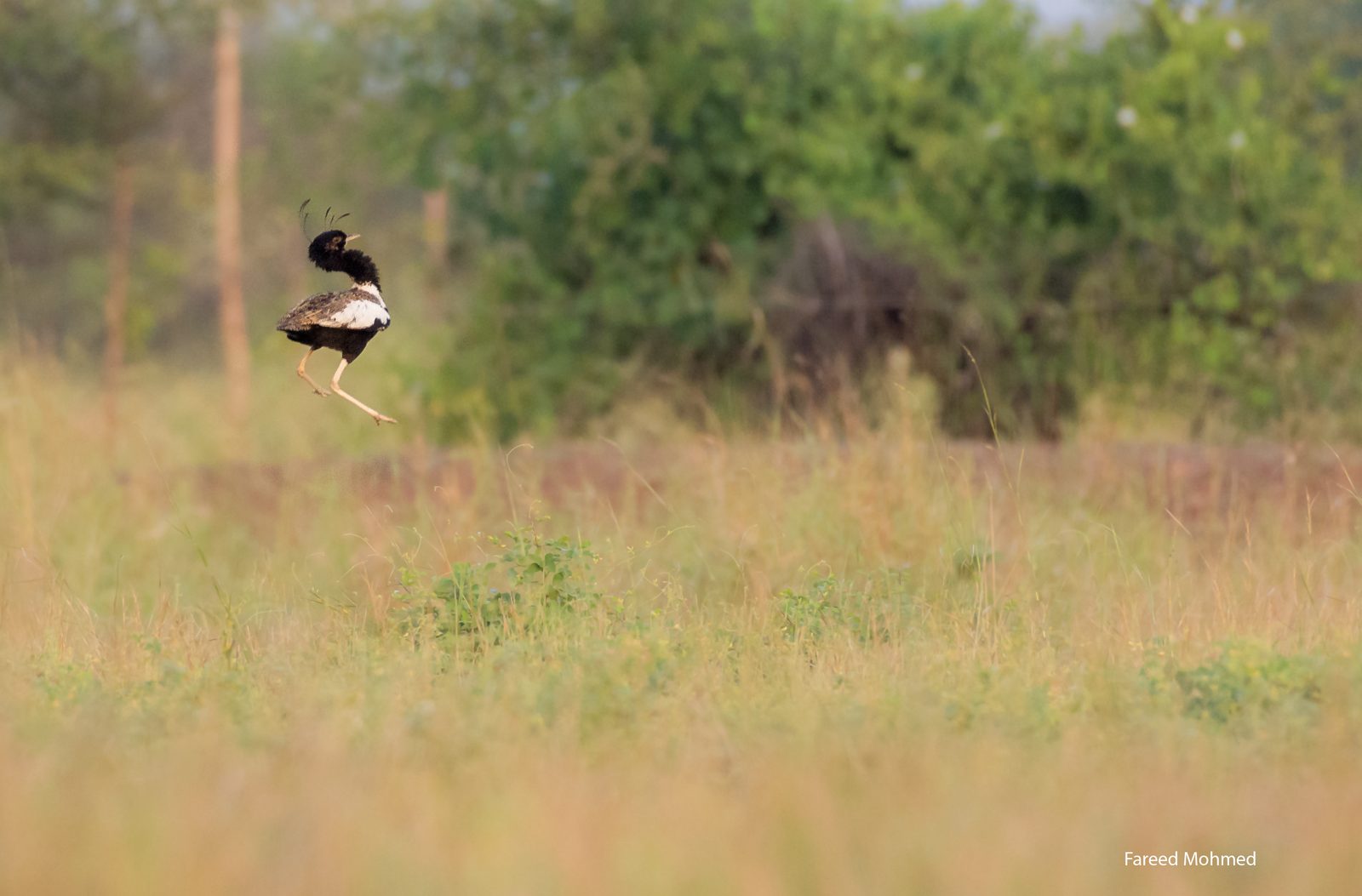
A bird that spends its life hidden in grass has a problem: how does a female ever find you?
The male's answer is to remove himself from the grass entirely. He crouches, then launches vertically — around two metres, clear of everything around him — with his head plumes streaming and a frog-like croak on the way up. He hangs for a moment, drops back, and vanishes. The whole thing takes about a second and a half.
He does it again. And again. A displaying male may leap several hundred times in a day, through the monsoon weeks when the grass is high and the females are choosing. It is the only reliable way to see the species, and the reason florican photography is done at dawn, at distance, from a stationary vehicle.
The rest of the year he is a brown bird in brown grass and effectively invisible — which is part of why counting them is so hard, and why the population figures carry the uncertainty they do.
The frames
004 frames · Rollapadu WLS · 15 September 2018
Field notes
Rollapadu Wildlife Sanctuary sits in Kurnool district, Andhra Pradesh — about 6 square kilometres of protected grassland in a landscape that is otherwise almost entirely farmed. It was declared for the Great Indian Bustard, which is now effectively gone from it. The floricans still turn up in the monsoon; the bustard no longer does.
These were made on the morning of 15 September 2018, from six o'clock, with three birds on the ground. The distances here are long — the frames are heavily cropped and there is nothing to be done about that. You do not walk towards a displaying florican. You find a vantage point before light, stay in the vehicle, and let the bird decide how close the morning gets.
The checklist for that morning is on eBird, and the photographs are archived in the Macaulay Library.