
Fareed Mohmed · Engineering
Motor & Gearbox Selector
Select · Pair · Apply
Pick one application and get the matching motor type and its preferred gearbox type together, plus the other gearbox types that would also work and when you'd choose them instead.
Find Motor + Gearbox by Application
Motor
Preferred Gearbox
Also Compatible
Visual Reference
Motor Types
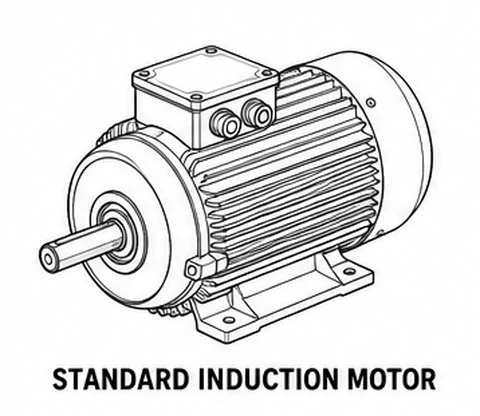
Standard Induction Motor
Robust, low-maintenance 3-phase motor running at a fixed speed set by supply frequency and pole count. No electronics required beyond switchgear and overload protection.
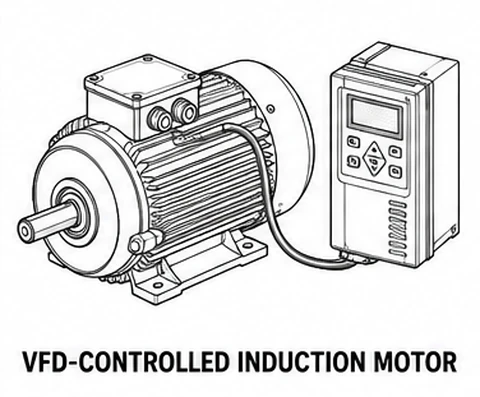
VFD-Controlled Induction Motor
The same induction motor, driven through a variable frequency drive so speed and torque can be adjusted electronically, with soft starting and stopping.
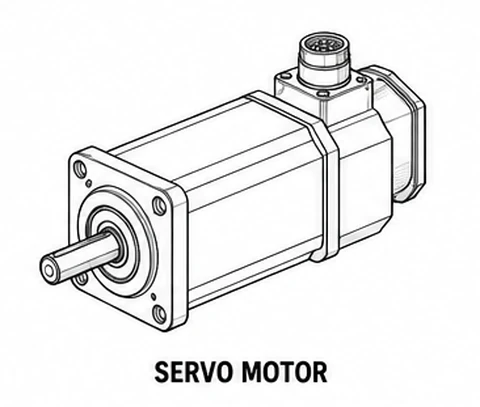
Servo Motor
A closed-loop motor with an integrated encoder feeding position and speed back to a servo drive, giving fast, precise, repeatable motion control.
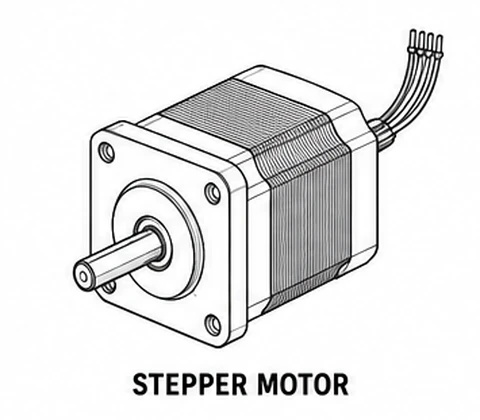
Stepper Motor
Moves in fixed angular steps driven open-loop by a controller — no feedback encoder needed for basic positioning, though it can lose steps if overloaded.
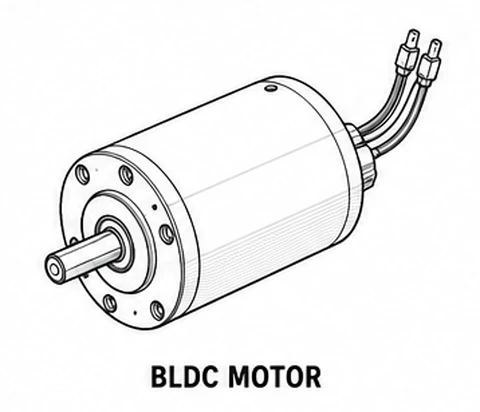
BLDC Motor
Brushless DC motor with electronic commutation — compact, efficient, and low-maintenance since there are no brushes to wear out.
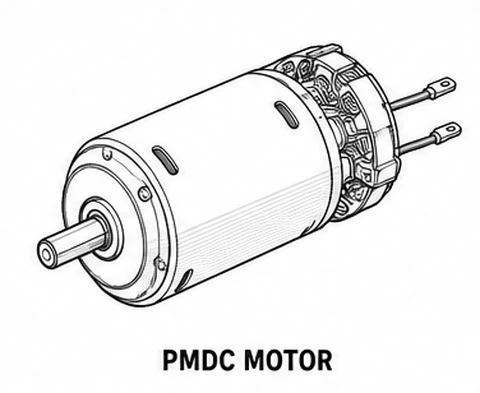
PMDC Motor
Permanent-magnet DC motor with brushes and a commutator — simple to control, since speed is roughly proportional to applied voltage, but brushes wear over time.
Gearbox Types
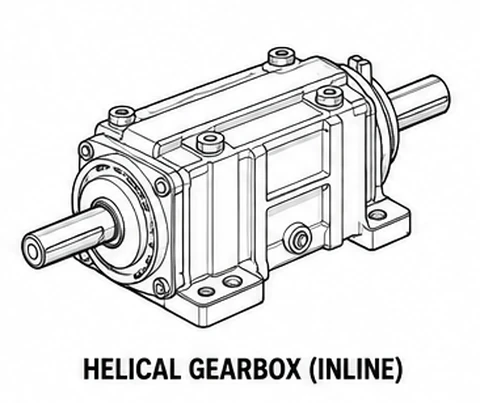
Helical Gearbox (Inline)
Parallel-shaft gearing with input and output on the same centerline. Smooth, quiet and efficient — the default choice for general-purpose reduction.
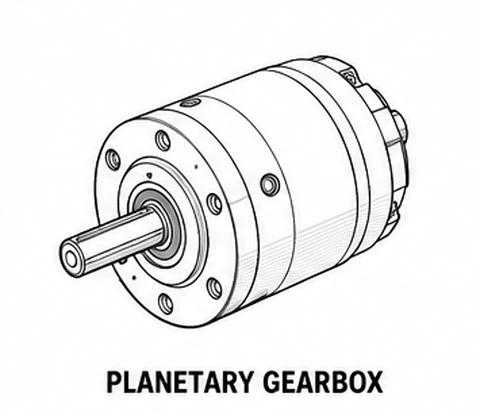
Planetary Gearbox
Load shared across multiple planet gears around a central sun gear, giving very high torque density in a compact, coaxial housing.
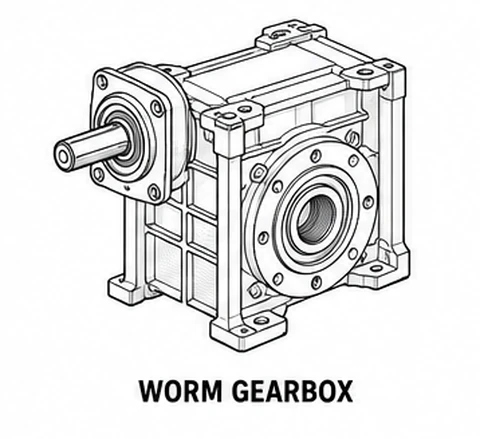
Worm Gearbox
A worm meshing with a wheel gives a compact right-angle reduction that's often self-locking at higher ratios — but efficiency drops sharply as the ratio climbs.
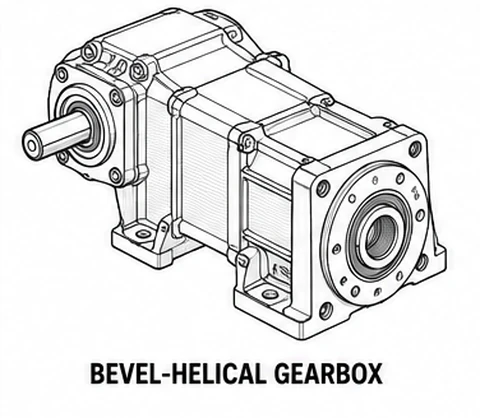
Bevel-Helical Gearbox
A helical reduction stage feeding a bevel gear pair for a right-angle output — higher efficiency and duty-cycle rating than a worm box, in a larger housing.
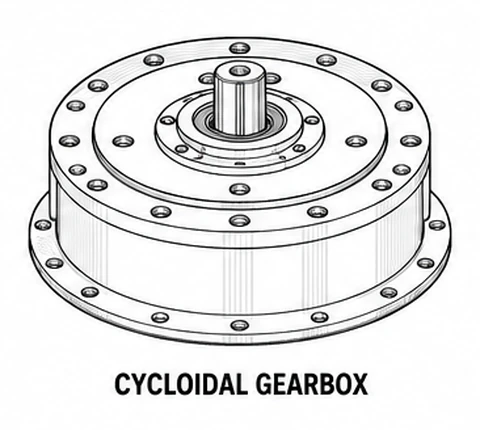
Cycloidal Gearbox
An eccentric cam and cycloidal disc give high ratios with very high shock-load tolerance in a broad, flat housing — noticeably more rugged under shock than a harmonic drive.
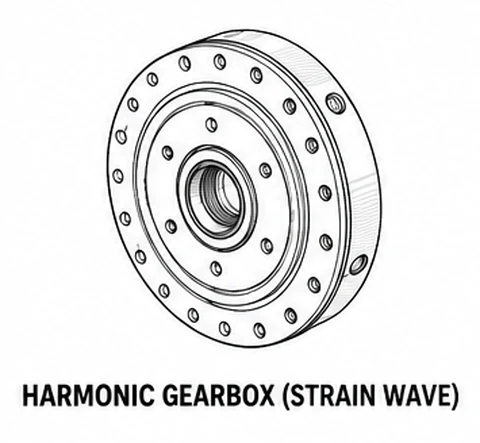
Harmonic Gearbox (Strain Wave)
A flexible spline flexed by an elliptical wave generator gives essentially zero backlash in the flattest, lightest housing of any gearbox type — but with lower shock tolerance than cycloidal.
Quick-Scan Table
Motor Types
| Type | Key Feature | Typical Use |
|---|---|---|
| Standard Induction Motor | Fixed speed, rugged, lowest cost | Constant-speed conveyor, fan or pump running continuously |
| VFD-Controlled Induction Motor | Adjustable speed, soft start/stop, same rugged motor | Variable-speed conveyor or pump needing soft start/stop and speed adjustment |
| Servo Motor | Closed-loop feedback, high precision, fast dynamic response | Precise positioning axis — pick-and-place, CNC, robotic arm |
| Stepper Motor | Open-loop stepped positioning, simple and low-cost | Open-loop precise positioning at low cost — 3D printer axis, small indexing table |
| BLDC Motor | Brushless, compact, high efficiency | Compact, efficient drive for mobile or battery-powered equipment (AGV, drone, e-bike) |
| PMDC Motor | Simple DC voltage speed control, brushed | Simple variable-speed drive from a DC supply — battery-powered hand tools, small actuators |
Gearbox Types
| Type | Key Feature | Typical Use |
|---|---|---|
| Helical Gearbox (Inline) | Inline shafts, smooth and efficient, general-purpose | General-purpose speed reduction with smooth, quiet, efficient operation |
| Planetary Gearbox | High torque density, compact and coaxial | High torque in a compact envelope where radial space is tight |
| Worm Gearbox | Compact right-angle, self-locking, moderate duty cycle | Compact right-angle drive where self-locking against back-drive is wanted |
| Bevel-Helical Gearbox | Right-angle output, higher efficiency than worm, larger housing | Right-angle drive needing higher efficiency and duty cycle than worm can give |
| Cycloidal Gearbox | High shock tolerance, high ratio, rugged | High shock-load tolerance and high ratio in a compact size — robotics joints, indexing tables |
| Harmonic Gearbox (Strain Wave) | Near-zero backlash, flattest and lightest, lower shock tolerance | Zero-backlash precision positioning in a very compact, lightweight package — robotic arm joints |
Explanatory Notes
Why one "preferred" gearbox instead of a fixed rule
For most applications more than one gearbox type would technically work — the preferred pick balances efficiency, backlash, shock tolerance, cost and duty cycle for the application as described. The compatible alternatives aren't wrong choices, just ones you'd reach for under a different constraint (tighter budget, higher shock loads, a right-angle output).
Open-loop vs. closed-loop motors
Standard induction, VFD-controlled induction, stepper and PMDC motors all run open-loop — they don't know their actual position or speed unless something else measures it. Servo motors add a feedback encoder, closing the loop so the drive can correct for load changes in real time. That's the difference that buys precision and repeatability, at a higher cost and more complex wiring.
Backlash and shock tolerance separate the precision gearboxes
Cycloidal and harmonic (strain wave) gearboxes both give high ratios in compact packages with very low backlash, but they aren't interchangeable: harmonic drives are flatter, lighter, and closer to zero backlash, while cycloidal gearboxes tolerate shock loading and reversals better. Picking between them is usually a shock-load question, not just a size or backlash question.
Related tools
Once you've picked a motor and gearbox type, size the actual ratio and check output speed/torque with the Motor & Gearbox Output Calculator. For the physical mounting arrangement, see Motor & Gearbox Mount Selector.