
Engineering · Tool 04
Bolt Grade Identification by Markings
Radial Lines · Stamped Numbers · Grade
A bolt head almost always tells you its grade, if you know what to look for. Select what's actually stamped or embossed on the head below, and it identifies the grade and strength band — or browse the full reference of SAE, ISO metric and stainless markings.
Reference only. An unmarked or illegible head should be treated as the lowest grade until proven otherwise — never assume a higher grade from context alone.
Identify by Markings
Select what you see stamped or embossed on the bolt head.
—
Strength
Visual Reference

SAE Grade 2
Blank head — no radial lines, no stamped numbers
SAE J429 Grade 2 — low or medium carbon steel, not heat-treated. The weakest of the common SAE grades and the easiest to misidentify, since a plain head could also just mean an unbranded or non-graded fastener.
StrengthMinimum tensile strength ≈ 74,000 psi (≈ 510 MPa) for sizes up to 3/4". Roughly comparable to metric class 4.6–5.8.

SAE Grade 5
Three evenly spaced radial lines
SAE J429 Grade 5 — medium carbon steel, quenched and tempered. The common mid-strength imperial bolt, widely used in general automotive and machine assembly.
StrengthMinimum tensile strength ≈ 120,000 psi (≈ 830 MPa). Roughly comparable to metric class 8.8.

SAE Grade 8
Six evenly spaced radial lines
SAE J429 Grade 8 — medium carbon alloy steel, quenched and tempered. The high-strength imperial grade, used where Grade 5 isn't enough.
StrengthMinimum tensile strength ≈ 150,000 psi (≈ 1035 MPa). Roughly comparable to metric class 10.9.

Metric Class 4.6
"4.6" stamped on the head
ISO 898-1 property class 4.6 — low-carbon steel, not heat-treated. The lightest-duty metric grade in common use.
StrengthUltimate tensile strength 400 MPa, yield ≈ 240 MPa.
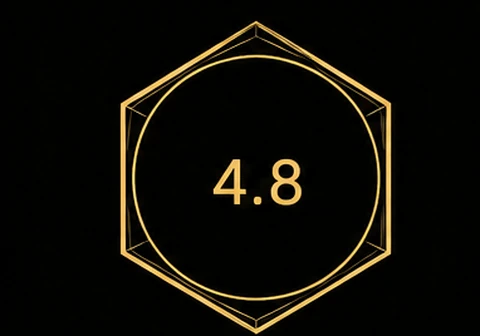
Metric Class 4.8
"4.8" stamped on the head
ISO 898-1 property class 4.8 — low-carbon steel, cold-worked. Slightly higher yield than 4.6 for the same ultimate strength band.
StrengthUltimate tensile strength 420 MPa, yield ≈ 340 MPa.

Metric Class 5.8
"5.8" stamped on the head
ISO 898-1 property class 5.8 — low-carbon steel, cold-worked. A common general-purpose grade, one step up from 4.8.
StrengthUltimate tensile strength 520 MPa, yield ≈ 420 MPa.

Metric Class 8.8
"8.8" stamped on the head
ISO 898-1 property class 8.8 — medium carbon steel, quenched and tempered. The everyday high-strength grade for structural and machine bolting.
StrengthUltimate tensile strength 800 MPa, yield ≈ 640 MPa.

Metric Class 9.8
"9.8" stamped on the head
ISO 898-1 property class 9.8 — used mainly on smaller-diameter screws rather than full-size structural bolts.
StrengthUltimate tensile strength 900 MPa, yield ≈ 720 MPa.

Metric Class 10.9
"10.9" stamped on the head
ISO 898-1 property class 10.9 — alloy steel, quenched and tempered. The common high-strength grade for structural steel connections.
StrengthUltimate tensile strength 1040 MPa, yield ≈ 940 MPa.

Metric Class 12.9
"12.9" stamped on the head
ISO 898-1 property class 12.9 — alloy steel, quenched and tempered. The highest common metric grade — strong but also the most brittle, and the least tolerant of being reused.
StrengthUltimate tensile strength 1220 MPa, yield ≈ 1100 MPa.
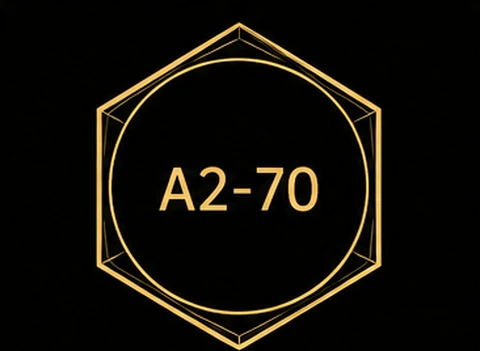
Stainless A2-70
"A2-70" stamped on the head
Austenitic stainless (similar to 304 grade), condition 70 — cold-worked. Non-magnetic, good general corrosion resistance. Chosen for corrosion resistance, not for maximum strength.
StrengthMinimum tensile strength 700 MPa — stronger than metric 4.6–5.8, but weaker than 8.8.
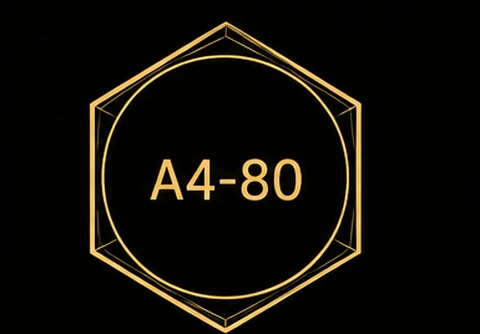
Stainless A4-80
"A4-80" stamped on the head
Austenitic stainless (similar to 316 grade), condition 80 — cold-worked. Better resistance to chlorides and marine environments than A2.
StrengthMinimum tensile strength 800 MPa — in the same band as metric 8.8, but chosen for corrosion resistance rather than strength.
Quick-Scan Table
| Grade | Marking | Strength |
|---|---|---|
| SAE Grade 2 | Blank head — no radial lines, no stamped numbers | Minimum tensile strength ≈ 74,000 psi (≈ 510 MPa) for sizes up to 3/4". Roughly comparable to metric class 4.6–5.8. |
| SAE Grade 5 | Three evenly spaced radial lines | Minimum tensile strength ≈ 120,000 psi (≈ 830 MPa). Roughly comparable to metric class 8.8. |
| SAE Grade 8 | Six evenly spaced radial lines | Minimum tensile strength ≈ 150,000 psi (≈ 1035 MPa). Roughly comparable to metric class 10.9. |
| Metric Class 4.6 | "4.6" stamped on the head | Ultimate tensile strength 400 MPa, yield ≈ 240 MPa. |
| Metric Class 4.8 | "4.8" stamped on the head | Ultimate tensile strength 420 MPa, yield ≈ 340 MPa. |
| Metric Class 5.8 | "5.8" stamped on the head | Ultimate tensile strength 520 MPa, yield ≈ 420 MPa. |
| Metric Class 8.8 | "8.8" stamped on the head | Ultimate tensile strength 800 MPa, yield ≈ 640 MPa. |
| Metric Class 9.8 | "9.8" stamped on the head | Ultimate tensile strength 900 MPa, yield ≈ 720 MPa. |
| Metric Class 10.9 | "10.9" stamped on the head | Ultimate tensile strength 1040 MPa, yield ≈ 940 MPa. |
| Metric Class 12.9 | "12.9" stamped on the head | Ultimate tensile strength 1220 MPa, yield ≈ 1100 MPa. |
| Stainless A2-70 | "A2-70" stamped on the head | Minimum tensile strength 700 MPa — stronger than metric 4.6–5.8, but weaker than 8.8. |
| Stainless A4-80 | "A4-80" stamped on the head | Minimum tensile strength 800 MPa — in the same band as metric 8.8, but chosen for corrosion resistance rather than strength. |
Explanatory Notes
Two marking systems, one purpose
SAE J429 (imperial/US) uses raised radial lines — the count is the grade minus 2, so Grade 5 gets 3 lines and Grade 8 gets 6. ISO 898-1 (metric) instead stamps the property class directly as a number, like "8.8" or "10.9". Neither system is "better" — they're just different national standards that happen to coexist on the same shelf.
Stainless markings aren't a strength scale
A2-70 and A4-80 look like they belong on the same ladder as 4.6 through 12.9, but they don't — the number after the dash is a minimum tensile strength in a different system (A2-70 = 700 MPa minimum, A4-80 = 800 MPa). Stainless is chosen for corrosion resistance first; treating "A4" as automatically stronger than "8.8" is a common and costly mistake.
An unmarked head isn't a low-grade guarantee
A blank head usually means SAE Grade 2 or an ungraded commodity fastener — but some manufacturers mark on the shank end or omit markings on small sizes entirely. When a marking genuinely can't be found or read, the safe assumption is the lowest plausible grade, not "probably fine."
Cross-reference with the other tools
Once a metric grade is identified here, the Bolt Grades tool gives its exact proof load, breaking load, shear strength and torque by diameter. For the fastener type itself, see Bolt Types & Applications.
Basis: SAE grades per SAE J429; metric property classes per ISO 898-1; stainless condition markings per ISO 3506. Strength figures are minimums per the respective standard, not guarantees for any specific bolt — always confirm against the manufacturer's certification for anything load-critical.