
Fareed Mohmed · Engineering
Bearing Type Selector for Machine Building
Select · Identify · Apply
Pick your application and find the matching bearing type — with a full visual reference of nine common rolling-element bearings and the plain sleeve bushing, and the reasoning behind each choice.
Find Bearing Type by Application
Visual Reference
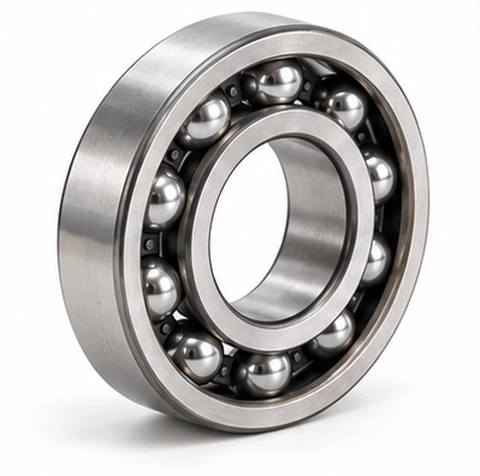
Deep Groove Ball Bearing
A single row of balls running in a deep circular groove between inner and outer ring. The general-purpose workhorse bearing — handles moderate radial load plus light axial load in either direction, runs quiet at high speed, and is the cheapest, most available option for a straightforward, well-aligned shaft.
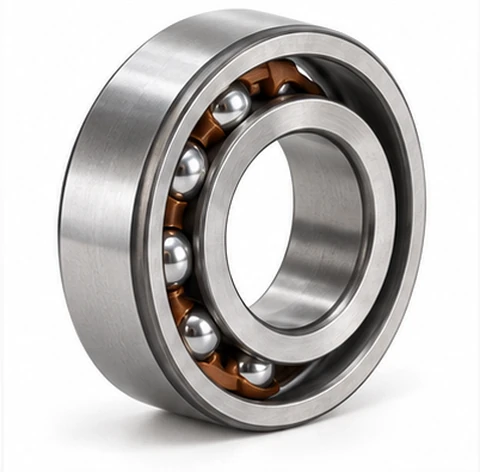
Angular Contact Ball Bearing
Balls contact the raceways at an angle rather than straight across, so the bearing carries a combined radial and one-directional axial load efficiently. Almost always mounted in pairs (back-to-back or face-to-face) to react thrust in both directions and add stiffness — the standard choice for precision, high-speed shafts.
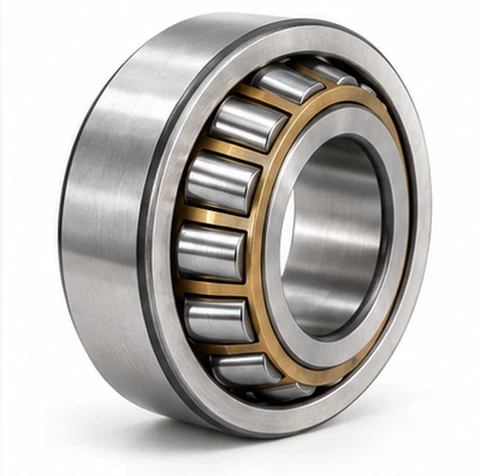
Cylindrical Roller Bearing
Short cylindrical rollers give far more radial load capacity than balls of the same envelope, at the cost of carrying little to no axial load. Many designs allow the inner and outer ring to float axially relative to each other, making this a common choice for the "non-locating" bearing on a shaft that must accommodate thermal growth.
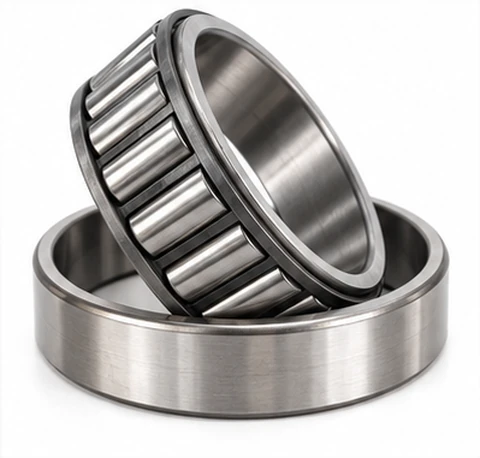
Tapered Roller Bearing
Cone-shaped rollers running on angled raceways carry heavy combined radial and one-directional thrust load. Like angular contact bearings they're mounted in opposing pairs to react thrust both ways — the standard choice wherever a shaft sees both heavy radial load and a meaningful axial component together.
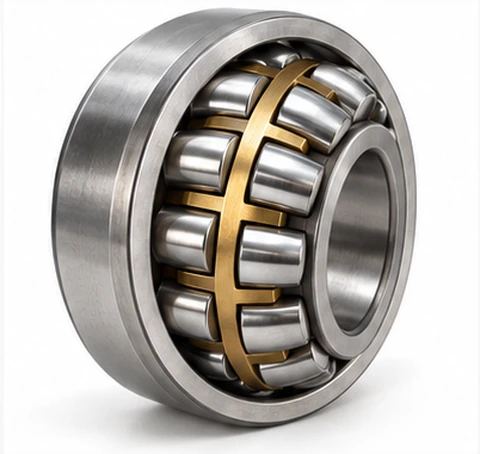
Spherical Roller Bearing
Two rows of barrel-shaped rollers run under a common spherical outer raceway, letting the inner ring rotate slightly out of true alignment with the outer ring without binding. Built for heavy, shock-loaded duty where the housing bore and shaft can't be guaranteed perfectly aligned.
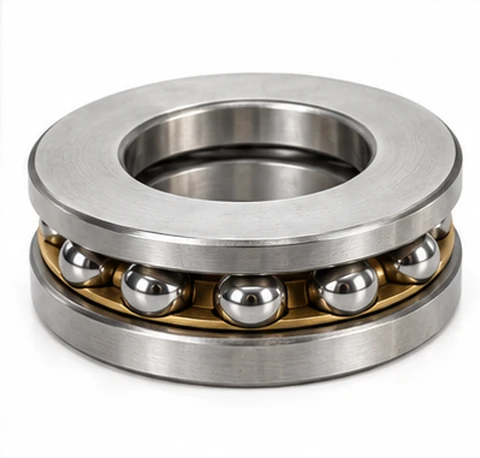
Thrust Ball Bearing
Two flat washers with a row of balls sandwiched between them, stacked axially rather than radially. Built to carry pure thrust load in a single direction only — it has essentially no radial load capacity and needs a separate bearing to locate the shaft radially.
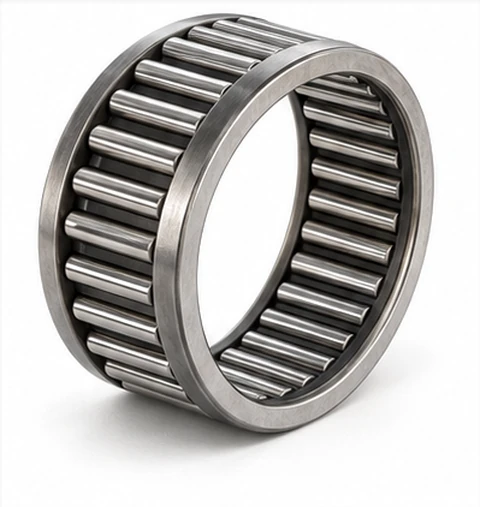
Needle Roller Bearing
Long, thin needle-shaped rollers pack a lot of rolling contact into a very small radial cross-section, giving high radial capacity in a tight envelope where a ball or standard roller bearing simply wouldn't fit.
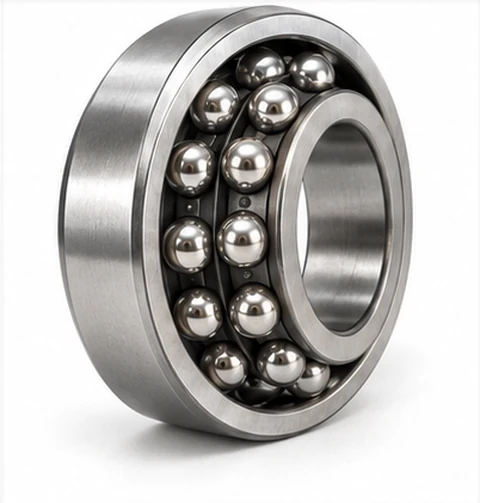
Self-Aligning Ball Bearing
Two rows of balls run under a common spherical outer raceway — the ball-bearing counterpart to the spherical roller bearing. Carries less radial load than a spherical roller bearing of the same size, but runs faster and quieter, for lighter-duty shafts where housing or shaft misalignment is still a concern.
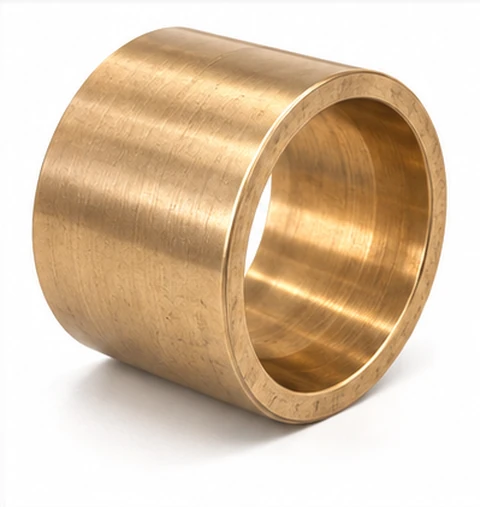
Plain / Sleeve Bushing
A simple sliding sleeve of bronze, sintered bronze or a polymer bearing material — no rolling elements at all. Load capacity is governed by the pressure-velocity (PV) limit of the bushing material rather than a rolling-contact rating. Cheap, simple, tolerant of dirt and contamination, and the standard choice for slow-speed pivots where a rolling-element bearing is overkill.
Quick-Scan Table
| Bearing Type | Radial Load | Axial Load | Speed | Misalignment |
|---|---|---|---|---|
| Deep Groove Ball Bearing | good | light, both directions | high | low tolerance |
| Angular Contact Ball Bearing | good | good, one direction (pair for both) | high | very low tolerance |
| Cylindrical Roller Bearing | very high | none to very limited | medium–high | very low tolerance |
| Tapered Roller Bearing | high | high, one direction (pair for both) | medium | low tolerance |
| Spherical Roller Bearing | very high | moderate, both directions | low–medium | high tolerance (self-aligning) |
| Thrust Ball Bearing | none / minimal | high, one direction only | low–medium | none |
| Needle Roller Bearing | high for its size | none (unless a combined type) | medium | very low tolerance |
| Self-Aligning Ball Bearing | moderate | light | medium–high | high tolerance (self-aligning) |
| Plain / Sleeve Bushing | moderate–high (PV limited) | none (unless flanged) | low–medium | some self-lubricating types tolerate light misalignment |
Explanatory Notes
Balls vs. rollers is a load-vs-speed trade-off
Ball bearings make point contact with the raceway, so they run faster and quieter but carry less load for a given size. Roller bearings make line contact, which trades some speed capability for substantially higher load capacity in the same envelope. If the shaft is heavily loaded and doesn't need to spin fast, reach for a roller type first.
Radial-only bearings still need something to locate the shaft axially
A cylindrical or needle roller bearing carrying pure radial load usually needs a second bearing elsewhere on the shaft — typically a deep groove or angular contact ball bearing — to fix the shaft's axial position and take up any thrust. Don't expect one radial-only bearing to do both jobs.
Self-aligning types solve a housing problem, not a load problem
Spherical roller and self-aligning ball bearings exist to tolerate shaft deflection or housing-bore misalignment that a rigid bearing can't absorb without extra internal stress and premature failure. If your housing bores are line-bored true and the shaft is stiff, a standard bearing is usually the better (and cheaper) choice — reach for a self-aligning type when alignment genuinely can't be guaranteed.
A plain bushing is often the right answer, not a compromise
For slow-speed, oscillating or lightly loaded pivots, a bronze or polymer sleeve bushing is cheaper, more tolerant of dirt and misalignment, and needs less maintenance than a rolling-element bearing — reserve the rolling-element types for where their higher speed capability or lower friction actually matters.
Related tools
Once you've identified a bearing type, four more tools carry the selection further: the Bearing Size Finder to shortlist a standard-series bearing by bore and envelope, the Bearing Arrangement Selector for how to mount the pair on the shaft, the Shaft & Housing Fit Calculator for the seat tolerances, and the Bearing Load, Life & Static Capacity Calculator to verify it against the actual loads. For the motor and gearbox feeding the shaft, see the Motor & Gearbox Selector.